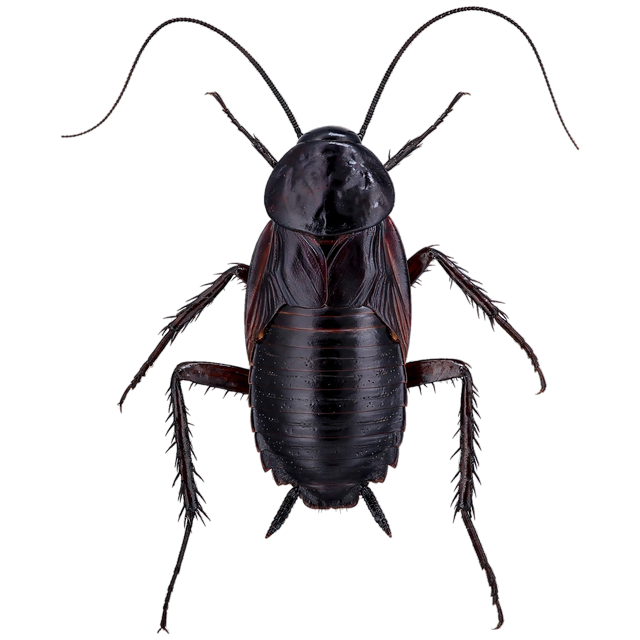
 Oriental cockroach
Blatta orientalis Linnaeus, 1758
Oriental cockroach
The cool-climate cockroach, dark, slow and damp-loving, at home in basements and sewers.
- Order
- Blattodea
- Family
- Blattidae
- Group
- Cockroaches
- Ontario status
- Established; tolerates cool damp basements; limited outdoor summer survival
Why it matters
Travels through sewers, drains and decaying matter, so it can carry germs. Its damp-habitat preference means it often signals a moisture problem in the building.
Origin
Despite the name, likely from North Africa or the Middle East; spread worldwide with trade.
Behavior
Nocturnal and slow-moving. Cannot climb smooth surfaces, so it stays low, it does not run up walls or across ceilings like other cockroaches.
Living conditions
The most cold-tolerant indoor cockroach. Loves damp, cool places, basements, crawl spaces, floor drains, sewers, under mulch in summer.
Signs of presence
- Large dark (nearly black) slow-moving cockroaches near floor drains or in basements
- Strong musty smell in damp enclosed areas
- Dark, blunt egg cases in damp debris
Weaknesses
- Cannot climb smooth vertical surfaces, stays at floor level
- Needs damp conditions; dry buildings exclude it
- Breeds slowly, one generation per year or fewer
Myths and facts
Myth All cockroaches need hot kitchens to survive.
Reality The Oriental cockroach prefers cool, damp basements and tolerates temperatures other cockroaches cannot.
Research notes
Morphology
Adults 20-30 mm (females larger), very dark brown to black, glossy. Males: wings cover ~3/4 of abdomen. Females: brachypterous (short, functionless wing pads). Nymphs dark reddish-brown. Lacks well-developed adhesive foot pads, cannot climb smooth surfaces.
Diagnostics
Confirm by dark glossy coloration + size + female short wings + inability to climb glass/smooth plastic. Strong musty odor when disturbed.
Easily confused with
- American cockroach, Periplaneta americana American is larger (35-50 mm), reddish-brown with a pale pronotal margin, and females are fully winged; Oriental is darker with short-winged females.
- Smokybrown cockroach, Validiblatta fuliginosa (syn. Periplaneta fuliginosa) Smokybrown is mahogany-brown, fully winged in both sexes and a strong flier; Oriental females are short-winged and neither sex climbs smooth surfaces.
Life cycle
- Adult
- Lifespan ~6-12 months.
- Egg
- Ootheca ~10 mm with ~16 eggs, deposited in damp debris or crevices ~30 hours after formation; hatches in ~42-60 days at warm temperatures.
- Egg to adult
- 6-12 months, the slowest of the common indoor cockroaches
- Generations per year
- ~1
- Nymph or larva
- 7-10 nymphal instars; slow development.
Development
Incomplete metamorphosis: egg → nymph → adult.
Reproduction
~16 eggs per ootheca; females produce oothecae roughly monthly in warm conditions.
Distribution
- Global
- Cosmopolitan in temperate and subtropical regions
- Native range
- Likely North Africa or the Middle East
- Ontario
- Established provincewide; tolerates cool damp basements; some summer outdoor survival near buildings
Ecology
Hygrophilic and cool-tolerant; associated with sewers, drains, damp basements, mulch and leaf litter. Poor climber, restricted to ground level and rough surfaces. Produces a strong musty aggregation odor.
Resistance
Insecticide resistance documented in some populations (pyrethroids); less studied than Blattella germanica.
IPM implications
Monitoring targets floor level and below: drains, sump pits, crawl spaces, damp basements. Moisture management is the primary ecological lever, drying the habitat suppresses it. Because it cannot climb smooth surfaces, sticky-trap placement and barrier logic differ from climbing species; smooth pitfall-style traps are effective.
Chemical ecology
Strong musty aggregation odor from cuticular and fecal compounds; used in harborage fidelity.
Genetics and DNA
High-resolution genome assembly published 2025 as part of the 47-genome termite comparative study.
Taxonomy
Order Blattodea, family Blattidae. Described by Linnaeus, 1758.
Open questions
Degree of outdoor overwintering possible in sheltered southern Ontario microhabitats.
References
- Ebeling, W. Urban Entomology, UC Riverside
- Mallis Handbook of Pest Control