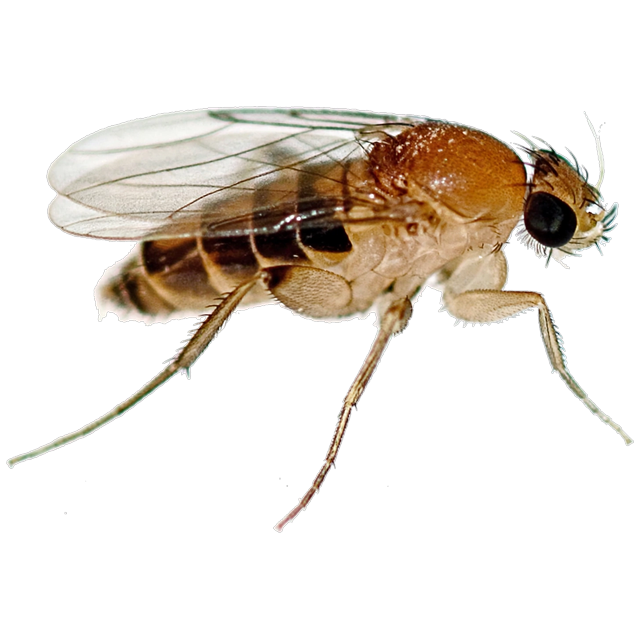
 Phorid fly
Megaselia scalaris Loew, 1866
Phorid fly
Tiny humpbacked flies that run instead of flying, and can breed in almost anything moist and decaying.
- Order
- Diptera
- Family
- Phoridae
- Group
- Flies
- Ontario status
- Established, common
Why it matters
Nuisance and contamination indicator. Their presence after drain cleaning means the real breeding site is hidden, a broken pipe, a wall void, a long-lost spill.
Origin
Probably tropical in origin; now worldwide wherever humans leave moist organic matter.
Behavior
Runs in short, jerky bursts instead of flying, the 'scuttle fly' habit. Tiny (2-4 mm). Does not bite.
Living conditions
The ultimate opportunist: drains, garbage, overwatered plant soil, carrion, famously called 'coffin flies' because they can reach buried remains.
Signs of presence
- Tiny humpbacked flies running (not flying) on counters and walls
- Flies persisting after drains are cleaned, the source is elsewhere
- Emergence near garbage areas, broken sewer lines, or dead animals
Weaknesses
- Every breeding site is a moist organic material, find it and remove it
- They reveal the source: adults stay close to where they breed
- Drying and sanitation end them; they have no resistant stage in homes
- Often the hidden source is under an appliance or inside a wall void, inspection beats spraying
Myths and facts
Myth They're just baby house flies.
Reality They are a completely different family, full-grown at 2-4 mm. Their humpback and running habit are the giveaways.
Research notes
Morphology
Adult 2-4 mm; thorax strongly arched (humpbacked), the instant field mark. Wing venation reduced, with heavy veins crowded along the leading edge (costa). Runs in short bursts; reluctant flier.
Diagnostics
Confirm by: 2-4 mm, humpbacked profile, reduced wing venation, scuttling run. No other tiny indoor fly combines the hump with the running habit.
Easily confused with
- Fruit fly, Drosophila melanogaster Fruit flies hover and fly readily with red eyes; phorids run, are humpbacked, and rarely sustain flight.
- Drain fly, Psychoda spp. Drain flies are moth-like and furry; phorids are smooth, dark, and humpbacked.
Life cycle
- Egg
- Laid on moist decaying matter of astonishing variety
- Nymph or larva
- Maggots feed on decaying organic matter, fungi, carrion; 3 instars
- Adult
- Lives 1-2 weeks; runs more than it flies
- Egg to adult
- Approximately 2-3 weeks at 25 °C
- Generations per year
- Continuous where breeding media persist
Development
Complete metamorphosis: egg → larva (3 instars) → pupa → adult.
Reproduction
Females exploit an extraordinary range of substrates, the species' success is its lack of pickiness.
Distribution
- Native range
- Probably pantropical
- Ontario
- Common indoors and around structures
- Global
- Cosmopolitan
Ecology
Breeding media: drains, garbage, carrion, fungi, plant material, animal waste. Forensically notable: adults can reach buried remains (the 'coffin fly' reputation). Poor dispersers, indoor populations mark a nearby source.
Resistance
Unknown, managed by source elimination; no resistance documented.
IPM implications
The biology makes this an inspection pest: adults' poor dispersal means the breeding site is within metres, under appliances, in wall voids from plumbing leaks, broken sewer lines, forgotten waste. Strategy is systematic source-hunting (often with drain cameras and moisture meters), then removal. Adult control without source removal is futile by life-cycle arithmetic.
Chemical ecology
Generalist attraction to decay volatiles; oviposition accepts an exceptionally broad substrate range, the chemical ecology is breadth, not specificity.
Genetics and DNA
No reference genome published as of 2026 (transcriptomic datasets exist).
Taxonomy
Diptera: Phoridae. Megaselia scalaris (Loew, 1866), one of the most ecologically flexible flies known; the genus Megaselia is enormous and taxonomically difficult.
Open questions
True species boundaries within the M. scalaris complex (likely cryptic species); the chemical cues behind its extreme substrate breadth.
References
- Disney (1994), Scuttle Flies: The Phoridae (Chapman & Hall), the family monograph
- Byrd & Castner (2010), Forensic Entomology (CRC Press), coffin-fly cases
- UF/IFAS Extension, phorid fly biology