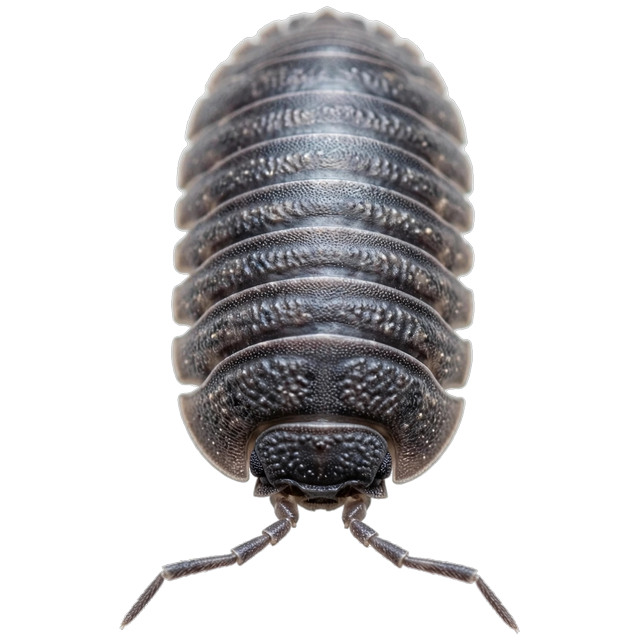
 Pillbug
Armadillidium vulgare (Latreille, 1804)
Pillbug
The roly-poly that rolls into a perfect ball when disturbed.
- Order
- Isopoda
- Family
- Armadillidiidae
- Group
- Occasional invaders
- Ontario status
- Established, common
Why it matters
A harmless nuisance and, like the sowbug, a moisture indicator. Indoors it signals dampness; outdoors in large numbers it can nibble seedlings and soft plant tissue in gardens.
Origin
Native to Europe; now cosmopolitan and long established in Ontario gardens, greenhouses, and damp structures.
Behavior
Nocturnal scavenger of decaying plant matter. Its signature move is volvation, rolling into a tight ball (conglobation) when disturbed, which protects its soft underside and gills. Harmless: no bite, no sting.
Living conditions
Same needs as the sowbug: constant moisture, darkness, and decaying organic matter. Found under pots, stones, mulch, and logs; indoors in damp basements and ground-floor rooms.
Signs of presence
- Round gray 'balls' under pots, stones, and doormats
- Sightings in damp basements and bathrooms
- Large numbers under mulch or leaf litter near the foundation
- Active at night and after rain
Weaknesses
- Desiccation, dry conditions are lethal
- Damp harborages against the building: mulch, leaf litter, stacked wood
- Ground-level entry gaps: doors, vents, foundation cracks
Myths and facts
Myth Pillbugs and sowbugs are the same thing.
Reality Close cousins, but the pillbug rolls into a ball and the sowbug cannot, the single best field character for telling them apart.
Myth They are baby armadillos or some kind of insect.
Reality They are terrestrial crustaceans, relatives of shrimp. The 'ball' is a defense, not a shell.
Research notes
Morphology
Adults 12-18 mm long; strongly convex, almost hemispherical body; dark gray to blackish, smooth dorsal surface; seven pereon segments; uropods short, not extending beyond the rear margin; capable of complete conglobation with no gaps.
Diagnostics
Convex profile plus complete volvation is diagnostic. Uropods hidden (vs. projecting in Porcellio). Smooth rather than granular dorsum.
Easily confused with
- Sowbug, Porcellio scaber The sowbug is flattened and cannot roll into a ball; the pillbug is rounded and can.
Life cycle
- Adult
- Lives 2-3 years; 1-3 broods per year, roughly 20-60 young per brood
- Egg
- Brooded roughly 3-4 weeks in the marsupium
- Egg to adult
- Several months, temperature-dependent
- Generations per year
- 1-2 outdoors in Ontario
- Nymph or larva
- Mancae; several molts over months to maturity
Development
Direct development. Eggs brooded in the marsupium; mancae emerge and molt about 5 times to maturity.
Reproduction
Sexual; females carry eggs in the marsupium. Brood size roughly 20-60.
Distribution
- Global
- Cosmopolitan in temperate regions
- Native range
- Europe (Mediterranean basin)
- Ontario
- Established, common in gardens, compost, greenhouses, and damp structures
Ecology
Detritivore; important decomposer in garden and forest-floor food webs. Conglobation reduces water loss and deters predators. Nocturnal; aggregates under cover objects.
Resistance
Unknown, not a pesticide target; no documented resistance.
IPM implications
Same moisture-and-exclusion logic as the sowbug: eliminate damp harborages against the foundation, correct drainage and ventilation, seal ground-level entries. Indoor individuals are incidental wanderers; persistent indoor presence warrants a moisture investigation, not a pesticide application.
Chemical ecology
No significant defensive chemistry; defense is mechanical (conglobation). Aggregation via thigmotaxis and humidity response.
Genetics and DNA
A reference genome exists: a 1.72 Gb ZW-female assembly (Chebbi et al.; NCBI GCA_004104545.1), a model resource for terrestrial-isopod sex determination and Wolbachia-symbiosis research.
Taxonomy
Order Isopoda, suborder Oniscidea, family Armadillidiidae. Armadillidium vulgare (Latreille, 1804), parentheses indicate original description in a different genus (Armadillo vulgaris).
Open questions
Genetic structure of introduced populations and the physiological limits of conglobation as a desiccation defense are not fully characterized.
References
- Penn State Extension, Sowbugs and Pillbugs
- University of Kentucky Entomology, Pillbugs and Sowbugs
- UC IPM, Sowbugs and Pillbugs