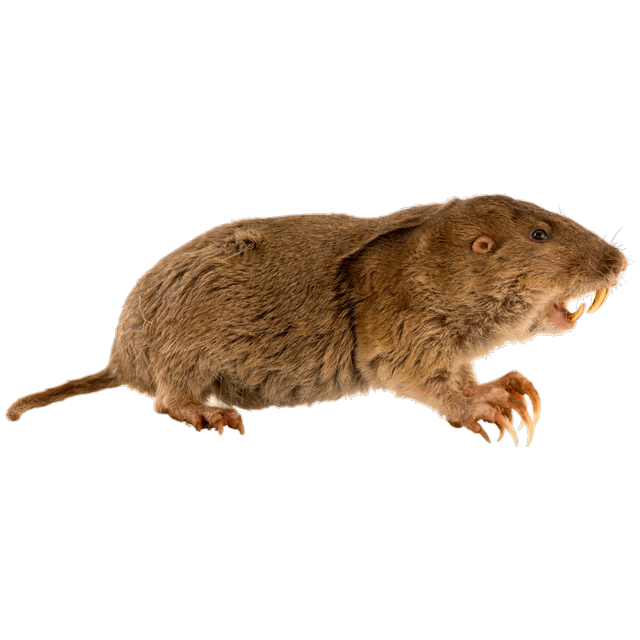
 Plains pocket gopher
Geomys bursarius (Shaw, 1800)
Plains pocket gopher
A burrowing western rodent that pushes fan-shaped mounds onto lawns.
- Order
- Rodentia
- Family
- Geomyidae
- Group
- Rodents
- Ontario status
- Not in Ontario, burrowing lawn pest of the western US
Why it matters
Not an Ontario concern, included as a reference species. Where it occurs (US Great Plains and west), it damages lawns, golf courses, and alfalfa by root feeding and mound building. Its mounds are constantly confused with mole mounds.
Origin
Native to the grasslands of central North America, a prairie animal, not an Ontario one. It does not occur in Ontario at all.
Behavior
Solitary and fiercely territorial, one gopher per burrow system. Active year-round, pushing excavated soil to the surface in fan-shaped mounds. Rarely seen above ground; even its foraging happens from below, pulling plants down into tunnels.
Living conditions
Deep, sandy, well-drained prairie soils where it can tunnel extensively. Lives almost entirely underground in burrow systems that can exceed 100 m of tunnels, feeding on roots and tubers.
Signs of presence
- Fan-shaped soil mounds with the plugged entrance hole off to one side (the key field mark)
- No visible surface runway, gophers work underground, unlike voles
- Plants wilting or vanishing as roots are eaten from below
- Long ridges of pushed-up soil (feeding tunnels) in soft ground
Weaknesses
- Completely soil-bound, cannot cross rocky ground, pavement, or waterlogged soil
- Solitary: each burrow system holds exactly one animal
- High energy cost of digging ties it to productive soils with abundant roots
- Vulnerable to predators on the rare occasions it surfaces to push soil
Myths and facts
Myth The mounds on my Ontario lawn are pocket gophers.
Reality Pocket gophers do not occur in Ontario. Lawn mounds here are moles (volcano-shaped) or ground squirrels, never gophers.
Research notes
Morphology
Head-body 180-240 mm, tail 50-110 mm, weight 200-400 g. Stocky, cylindrical body; huge procumbent incisors worn by digging; tiny eyes and ears; short nearly naked tail used as a tactile probe when reversing in tunnels.
Diagnostics
Confirm by: fan-shaped mound with the plugged burrow entrance offset to one side, mole mounds are volcano-shaped with a central plug. Cheek pouches open externally (hamster-like), unlike the internal pouches of chipmunks.
Easily confused with
- Eastern mole, Scalopus aquaticus Mole mounds are symmetrical volcanoes with a central plug; gopher mounds are fan-shaped with the plug off to one side. (An academic distinction in Ontario, gophers don't occur here.)
Life cycle
- Egg
- N/A, viviparous
- Nymph or larva
- Pups weaned at ~5 weeks; disperse above ground to found their own burrows, the highest-mortality phase
- Adult
- Lifespan 2-3 years in the wild; breeds the spring after birth
- Egg to adult
- Gestation ~30 days; single litter raised underground
- Generations per year
- 1-2 litters per year
Development
Viviparous; altricial young born in a nest chamber deep in the burrow.
Reproduction
3-6 pups per litter × 1-2 litters/year.
Distribution
- Native range
- Great Plains of central North America
- Ontario
- Absent from Ontario, occurs in Canada only in extreme southern Manitoba (Roseau River area near Emerson)
- Global
- Central North America only
Ecology
Strictly subterranean herbivore: roots, tubers, and bulbs eaten underground; forbs pulled down from the surface. Burrow systems of 100 m+ with food caches and nest chambers 1-2 m deep. Does not hibernate.
Resistance
N/A, not a pesticide target species.
IPM implications
Reference species only for Ontario readers. Diagnostic value: the fan-vs-volcano mound distinction is the standard teaching character separating gopher from mole sign, the single most useful fact this dossier carries for the Ontario track.
Chemical ecology
Scent glands mark burrow walls; solitary territoriality is chemically advertised. Limited published work on geomyid semiochemistry.
Genetics and DNA
No reference genome published as of 2026.
Taxonomy
Rodentia: Geomyidae. Geomys bursarius (Shaw, 1800), the 'pocket' refers to the external fur-lined cheek pouches used to carry food.
Open questions
Fine-scale population genetics across the fragmented prairie range.
References
- Vaughan et al., Mammalogy, Jones & Bartlett, geomyid biology
- Case & Jasch, 'Pocket gophers' in Hygnstrom et al. (eds.), Prevention and Control of Wildlife Damage, Univ. of Nebraska