 Powderpost beetle
Lyctus spp. Fabricius, 1792
Powderpost beetle
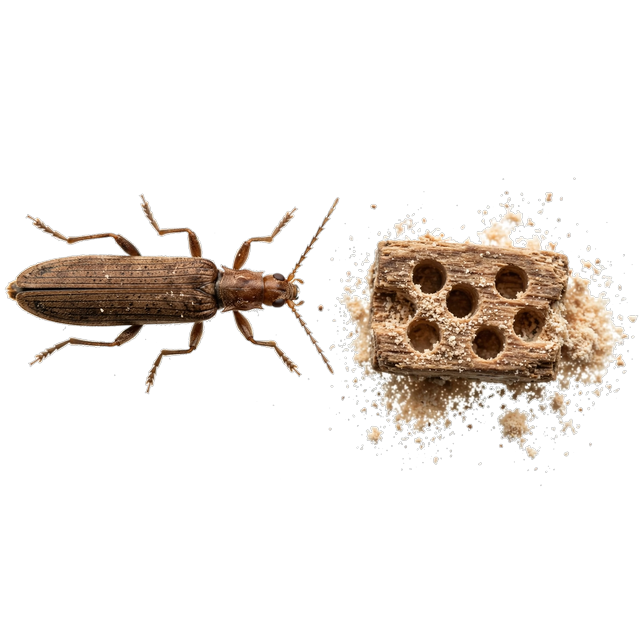
A beetle whose larvae turn hardwood sapwood into fine flour, leaving tiny shot-holes and piles of powder as their signature.
- Order
- Coleoptera
- Family
- Bostrichidae
- Group
- Fabric & structural beetles
- Ontario status
- Established, in Ontario hardwood flooring, furniture, trim, and lumber; the true powderpost beetles
Why it matters
The main wood-boring beetle of Ontario hardwood flooring and furniture. Damage is usually cosmetic-to-moderate, but in flooring it can be extensive, and it is a standard exam identification.
Origin
Several Lyctus species worldwide; the group evolved to exploit the starchy sapwood of hardwoods.
Behavior
Females lay eggs in wood pores. Larvae tunnel for about a year, packing galleries with fine powder, then chew round exit holes as adults. Infestations usually arrive in the wood product itself.
Living conditions
Only the sapwood (outer, lighter wood) of hardwoods, oak, ash, maple, walnut, and only while it still contains starch. New flooring, furniture, and trim are the classic Ontario sites.
Signs of presence
- Round exit holes 1-2 mm (like pinpricks to small shot) in hardwood
- Fine flour-like powder (frass) sifting from the holes, no pellets, no grit
- Fresh holes and powder in new flooring or furniture
Weaknesses
- Only attacks sapwood with starch, heartwood and old, starch-depleted wood are immune
- Cannot reinfest the same wood indefinitely; starch runs out
- Kiln-dried and properly finished wood is rarely attacked
- Small emergence holes (1-2 mm) make infestations easy to spot early
Myths and facts
Myth Powderpost beetles will eat through my whole house frame.
Reality They only eat hardwood sapwood with starch, your pine framing is not on the menu, and they cannot live in the same wood forever.
Research notes
Morphology
Adults 2-7 mm, slender, flattened, brown. Larvae C-shaped, white, up to ~6 mm. Exit holes round, 1-2 mm diameter. Frass is fine, flour-like powder with no pellets, the diagnostic character.
Diagnostics
Flour-fine frass + 1-2 mm round holes + hardwood sapwood = Lyctus powderpost. Frass texture separates it from anobiids (gritty, pellet-like) and old house borer (packed, fibrous).
Easily confused with
- Old house borer, Hylotrupes bajulus Old house borer: larger oval holes (6-10 mm) in softwood with packed frass. Powderpost: 1-2 mm round holes in hardwood with flour-fine loose frass.
- Drugstore beetle, Stegobium paniceum Anobiid frass is gritty with tiny pellets, not flour-fine; and drugstore beetles attack stored products, not structural hardwood.
Life cycle
- Adult
- Emerge through round holes; live weeks; mate and re-lay in the same or nearby wood
- Egg
- Laid in wood pores and cracks, ~1 mm
- Egg to adult
- ~1 year typical; longer in poor wood
- Generations per year
- 1
- Nymph or larva
- Larvae tunnel 9-12 months, packing galleries with powder frass
Development
Complete metamorphosis: egg → larva → pupa → adult, entirely within sapwood.
Reproduction
Females lay eggs only in open wood pores, large-pored hardwoods (oak, ash) are most susceptible; small-pored woods resist.
Distribution
- Global
- Cosmopolitan in hardwood commerce
- Native range
- Multiple species, worldwide
- Ontario
- Established; hardwood flooring, furniture, millwork
Ecology
Starch-dependent: larvae require sapwood starch, which declines with wood age, the infestation is self-limiting over years. Moisture content 8-15% typical.
Resistance
Unknown, no significant documented resistance.
IPM implications
Prevention is in the lumber: kiln-drying, starch depletion with age, and surface finishes that seal pores. Active infestations are localized to the wood member, replacement or targeted treatment of the piece, not the building. Because starch depletes, old damage is often inactive: fresh powder distinguishes active from historic.
Chemical ecology
Wood volatiles and starch cues guide oviposition; pheromone work limited.
Genetics and DNA
No reference genome published as of 2026.
Taxonomy
Order Coleoptera, family Bostrichidae, subfamily Lyctinae. 'True powderpost beetles' = Lyctus and close relatives; distinguished from anobiid and bostrichid wood borers by frass and host.
Open questions
Starch-threshold mapping across commercial hardwood species; non-chemical disinfestation of finished flooring.
References
- Ebeling, W. (1978). Urban Entomology. University of California, Riverside.
- Hickin, N.E. (1963). The Insect Factor in Wood Decay. Hutchinson.