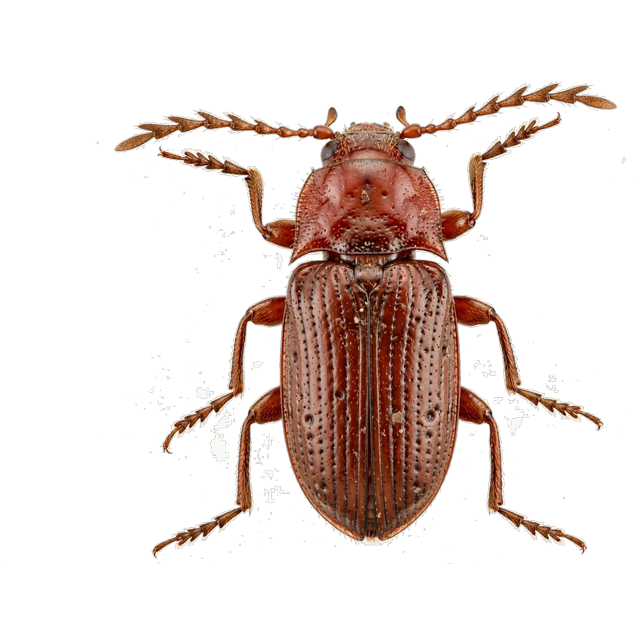
 Red flour beetle
Tribolium castaneum (Herbst, 1797)
Red flour beetle
The lab rat of the beetle world, a flour pest so well studied that scientists sequenced its entire genome.
- Order
- Coleoptera
- Family
- Tenebrionidae
- Group
- Stored-product beetles
- Ontario status
- Established, cosmopolitan in Ontario mills, bakeries, and pantries; a warm-climate species indoors
Why it matters
A top-tier pest of flour mills and a common pantry invader. Beyond the kitchen, it is one of the most important model organisms in genetics, the first beetle with a sequenced genome.
Origin
Originally from the Indo-Australian region; now everywhere flour is milled and stored.
Behavior
Can fly but usually walks. Active year-round in heated buildings. Both adults and larvae feed, and large populations give flour a sharp, disagreeable odor from defensive secretions.
Living conditions
Lives in flour, cereal, cake mix, pet food, and grain dust, it thrives in the fine material that collects in pantry cracks and under appliances. Cannot chew whole kernels; needs milled or broken grain.
Signs of presence
- Tiny reddish beetles (3-4 mm) in flour or crawling from box seams
- Flour that smells sharp or musty and may look slightly pink from secretions
- Beetles in the cracks of cupboards and under shelf paper
Weaknesses
- Killed by freezing
- Cannot survive on whole intact kernels
- Populations crash when food residues are thoroughly cleaned out, it lives in the crumbs, not the house
Myths and facts
Myth Flour beetles mean the house is dirty.
Reality They arrive in the product from the store or mill. A single infested bag seeds the whole cupboard, cleanliness helps only after the source is removed.
Research notes
Morphology
3-4 mm, reddish-brown, flattened. Antennae with a distinct abrupt 3-segmented club. Eyes narrowly separated beneath (about one eye-width apart or less). Capable of flight.
Diagnostics
Abrupt antennal club + narrow eye separation beneath = red flour beetle. Compare directly against T. confusum specimens.
Easily confused with
- Confused flour beetle, Tribolium confusum Red flour beetle: abrupt 3-segmented antennal club, eyes nearly touching beneath, can fly. Confused: gradual club, eyes widely separated, flightless.
Life cycle
- Adult
- Live 1+ years; females lay for most of adult life
- Egg
- Tiny, laid loosely in flour; hatch in under a week at 30 °C
- Egg to adult
- 4-7 weeks at 30 °C; months at cool temperatures
- Generations per year
- 4-7 indoors
- Nymph or larva
- Slender cylindrical larvae, ~6 mm at maturity, feed 3-5 weeks; pupate naked in the flour
Development
Complete metamorphosis: egg → larva → pupa → adult.
Reproduction
Females lay 300-500+ eggs lifetime; enormous biotic potential in warm flour.
Distribution
- Global
- Cosmopolitan; the dominant Tribolium in warm regions
- Native range
- Indo-Australian region
- Ontario
- Established in heated mills, bakeries, and homes; cannot overwinter outdoors
Ecology
Secondary colonizer of milled products; defensive benzoquinone secretions taint flour and deter predators. Aggregation pheromone (4,8-dimethyldecanal) concentrates populations.
Resistance
Phosphine resistance is widespread and well characterized, among the strongest documented cases in stored-product beetles, involving rph1/rph2 resistance genes (dihydrolipoamide dehydrogenase). Also documented resistance to several contact insecticides and the fumigant sulfuryl fluoride in some populations.
IPM implications
Resistance status makes this a monitoring-first pest: phosphine fumigation cannot be assumed effective, resistance testing precedes fumigation decisions in commercial storage. In homes, sanitation (removing the infested flour and residues) remains decisive because the beetle cannot fly far or penetrate sealed containers reliably.
Chemical ecology
Male-produced aggregation pheromone 4,8-dimethyldecanal (tribolure); defensive benzoquinone secretions from abdominal glands that also serve antimicrobial functions.
Genetics and DNA
Reference genome published 2008, Tribolium Genome Sequencing Consortium, Nature 452:949-955. A premier genetic model for Coleoptera; extensive mutant and RNAi resources.
Taxonomy
Order Coleoptera, family Tenebrionidae (darkling beetles). Genus Tribolium; separated from T. confusum by antennal club and eye spacing.
Open questions
Fitness costs of phosphine-resistance alleles in untreated refugia; population structure across the global grain trade.
References
- Tribolium Genome Sequencing Consortium (2008). The genome of the model beetle and pest Tribolium castaneum. Nature, 452:949-955.
- Hagstrum, D.W. & Subramanyam, B. (2006). Fundamentals of Stored-Product Entomology. AACC International.
- Phillips, T.W. & Throne, J.E. (2010). Biorational approaches to managing stored-product insects. Annual Review of Entomology, 55:375-397.