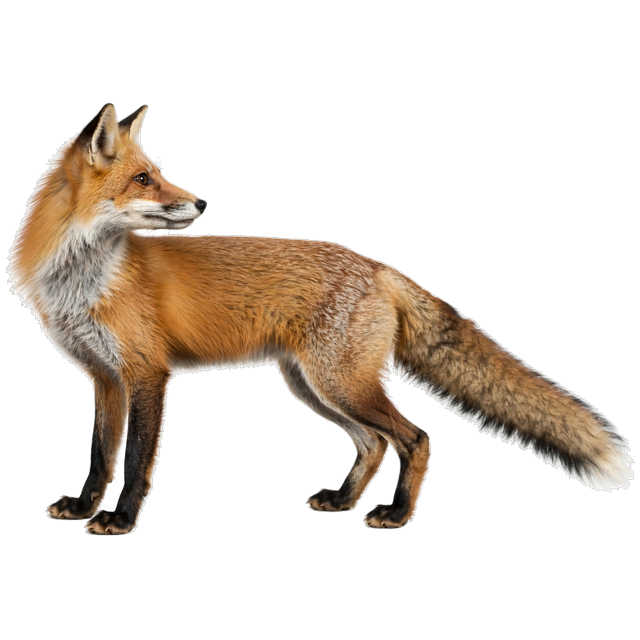
 Red fox
Vulpes vulpes (Linnaeus, 1758)
Red fox
A rust-red wild canid common in suburbs across Ontario.
- Order
- Carnivora
- Family
- Canidae
- Group
- Wildlife
- Ontario status
- Established, common provincewide, urban and rural
Why it matters
A rabies-vector species in Ontario, any fox acting strangely (daytime boldness, staggering, unprovoked aggression) must be treated as a potential rabies case and reported. Otherwise, foxes are free rodent control; a family eats thousands of mice and voles a year.
Origin
Native across the northern hemisphere, one of the most widespread wild carnivores on Earth. Ontario's foxes were here long before the cities grew around them.
Behavior
Mostly nocturnal and crepuscular in settled areas; shyer by day. Solitary hunter of mice and voles, pouncing with the classic stiff-legged leap. Family groups raise kits at the den in spring; young disperse in autumn.
Living conditions
Remarkably flexible: farmland edges, ravines, suburbs, and city green space. Dens in earth burrows, or under decks, sheds, and porches in towns. Needs cover for denning and a steady supply of small prey.
Signs of presence
- Dog-like tracks ~50 mm long in a straight-line trot pattern
- Twisted, tapered droppings with hair and berry seeds, left prominently as scent marks
- Earthy dens with a fan of excavated soil under sheds or in banks
- High-pitched barks and eerie screams at night in breeding season (winter)
Weaknesses
- Dependent on small-mammal prey, crash the local mouse and vole supply and foxes move on
- Needs undisturbed den sites; persistent human activity at a den drives relocation
- Young dispersers in autumn are the wandering, road-vulnerable age class
- Susceptible to canine distemper and sarcoptic mange, which cycle through populations
Myths and facts
Myth Foxes stalk children and pets.
Reality Healthy foxes avoid people and are far too small to threaten children; they want mice, not pets. Bold daytime behavior is abnormal, report it.
Myth Seeing a fox means rabies.
Reality Most sightings are healthy animals going about their business. Rabies is suspected only with abnormal behavior: staggering, paralysis, or unprovoked aggression.
Research notes
Morphology
Head-body 550-750 mm, tail 350-550 mm with a white tip, weight 3-7 kg (males larger). Rust-red coat, black ear backs and lower legs, white-tipped bushy tail, the tail tip is the quick field mark.
Diagnostics
Confirm by: white-tipped tail, black 'socks' on the legs, and a narrow muzzle. Tracks show four toes with claw marks in a neat straight-line trot, domestic dog tracks wander and splay.
Easily confused with
- Coyote, Canis latrans Coyote is roughly twice the weight (9-16 kg) with a black-tipped tail and heavier muzzle; fox tracks are ~50 mm, coyote ~65 mm.
- Gray fox, Urocyon cinereoargenteus Gray fox is grizzled gray with a black-tipped tail and climbs trees; the red fox never climbs and its tail tip is white.
Life cycle
- Egg
- N/A, viviparous
- Nymph or larva
- Kits born March, April, blind ~9 days; emerge from the den at 4-5 weeks; hunt with parents through summer
- Adult
- Lifespan 2-4 years in the wild (9+ in captivity); breeds in its first winter
- Egg to adult
- Gestation ~52 days; kits independent by autumn
- Generations per year
- 1 litter per year
Development
Viviparous; altricial kits born blind in an earth den.
Reproduction
4-6 kits per litter × 1 litter/year; both parents provision the young.
Distribution
- Native range
- Holarctic, North America, Europe, Asia, North Africa
- Ontario
- Established provincewide, from wilderness to downtown Toronto ravines
- Global
- The most widespread wild canid on Earth; introduced to Australia
Ecology
Opportunistic omnivore: voles and mice first, plus rabbits, birds, insects, berries, and human refuse in cities. Territorial pairs hold 2-10 km² ranges. Caches surplus food in shallow scrapes. Dens reused across years.
Resistance
N/A, not a pesticide target species.
IPM implications
Monitoring: tracks, scat, and den-site mapping establish territory and activity. Exclusion of poultry and food waste removes attractants; persistent denning under structures is resolved by exclusion after kits disperse in autumn, never during the denning season. Any abnormal behavior triggers a rabies-protocol response, not a wildlife-control response. FWCA licensing applies to any intervention.
Chemical ecology
Urine and feces mark territory boundaries; the supracaudal ('violet') gland on the tail base deposits scent on objects. Skunk-like musk from anal glands when excited.
Genetics and DNA
Reference genome published: Kukekova et al. 2018 (Nature Ecology & Evolution); chromosomal assembly 2025 (PMC11842965).
Taxonomy
Carnivora: Canidae. Vulpes vulpes (Linnaeus, 1758), the largest of the true foxes, with ~45 described subspecies worldwide.
Open questions
Urban den-site selection criteria in the GTA; the contribution of fox predation to urban rodent suppression is unquantified.
References
- Naughton, D. (2012) The Natural History of Canadian Mammals, Univ. of Toronto Press
- Voigt & Macdonald, in Macdonald & Sillero-Zubiri (eds.), The Biology and Conservation of Wild Canids, Oxford Univ. Press