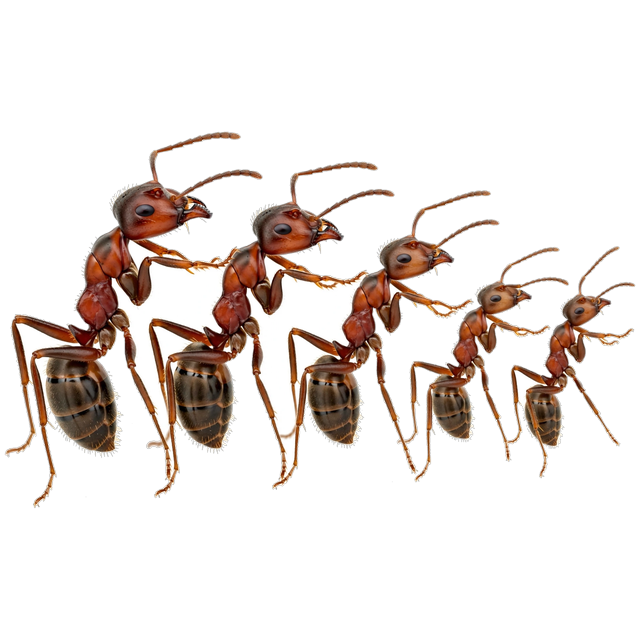
 Red imported fire ant
Solenopsis invicta Buren, 1972
Red imported fire ant
The infamous stinging ant of the American South, not in Canada, included as the reference standard.
- Order
- Hymenoptera
- Family
- Formicidae
- Group
- Ants
- Ontario status
- Not present in Ontario or Canada, reference only (southern US quarantine pest)
Why it matters
A major medical, agricultural and ecological pest in the southern US, stings cause painful pustules and occasionally severe allergic reactions. In Canada its role is as the reference species for Solenopsis identification and invasion biology.
Origin
South America (Paraguay River basin); accidentally introduced to the US South in the 1930s via ship cargo.
Behavior
Extremely aggressive defenders, disturbs a mound and hundreds of workers swarm out, each stinging repeatedly. Forages in underground tunnels radiating from the mound.
Living conditions
Builds large soil mounds in open, sunny areas, lawns, pastures, roadsides. Needs a long warm season; cannot survive Canadian winters.
Signs of presence
- Not expected in Canada, large reddish ant mounds are a US southern phenomenon
- Aggressive swarming and painful stings when a mound is disturbed
- Quarantine interceptions occur in imported nursery stock and freight at ports of entry
Weaknesses
- Cold-intolerant, winter is the absolute barrier to Canadian establishment
- Mounds are large and obvious, making nests easy to find
- Colonies are tied to their mound network
Myths and facts
Myth Fire ants are marching toward Canada.
Reality Cold tolerance is the hard limit; established populations remain far south of the Canadian border.
Research notes
Morphology
Polymorphic workers 2-6 mm, reddish-brown head and thorax with darker brown-black gaster. 10-segmented antennae with 2-segmented club. Two-segmented waist; propodeum unarmed. Stinger present (all workers female).
Diagnostics
Confirm by polymorphic reddish workers + mound nesting + aggressive swarming sting response + 10-segmented antennae with 2-segmented club.
Easily confused with
- Thief ant, Solenopsis molesta Thief ant is much smaller (1.3-1.8 mm), monomorphic, yellow, and does not sting aggressively or build large mounds; same genus, very different biology.
Life cycle
- Adult
- Workers live ~1-3 months; queens live 6+ years.
- Egg
- Eggs hatch in ~1-2 weeks at warm temperatures.
- Egg to adult
- ~30-45 days at 28-32 °C
- Generations per year
- Continuous in warm climates
- Nymph or larva
- Legless larvae; naked pupae.
Development
Complete metamorphosis: egg → larva → pupa → adult.
Reproduction
Colonies 100,000-500,000 workers; monogyne (single queen) and polygyne (multiple queen) social forms. Nuptial flights produce new mounds; polygyne colonies also bud.
Distribution
- Global
- Southern US, parts of Australia, China, Taiwan; expanding in warm regions
- Native range
- South America (Paraguay/Paraná basin)
- Ontario
- Absent, not present in Canada
Ecology
Dominant invasive; mound-building in open sunny habitats; omnivorous with strong protein preference; displaces native ants. Foraging via subterranean tunnels up to tens of metres.
Resistance
Some insecticide tolerance documented; the primary management story is area-wide quarantine and bait programs rather than resistance.
IPM implications
Reference-only for Ontario. Where established: mound-targeted colony elimination is the unit of management; forager suppression is ineffective against half-million-worker colonies. Quarantine and early-detection surveillance are the regulatory tools. Included here as the Solenopsis reference standard and invasion-biology case study.
Chemical ecology
Alkaloid venom (solenopsins), the sting chemistry; trail and recruitment pheromones; queen pheromones regulating worker reproduction.
Genetics and DNA
Genome sequenced 2011, among the first ant genomes; revealed the social chromosome (Gp-9 supergene) underlying monogyne/polygyne social forms (Wurm et al., PNAS).
Taxonomy
Order Hymenoptera, family Formicidae, subfamily Myrmicinae, genus Solenopsis. Described by Buren, 1972. South American native; invasive in the US, Australia, Asia.
Open questions
Northern range expansion limits under climate change; whether any Canadian establishment is plausible this century (current models: no).
References
- Wurm et al. 2011, PNAS (genome)
- Hölldobler, B. & Wilson, E.O. 1990, The Ants, Harvard University Press
- Mallis Handbook of Pest Control