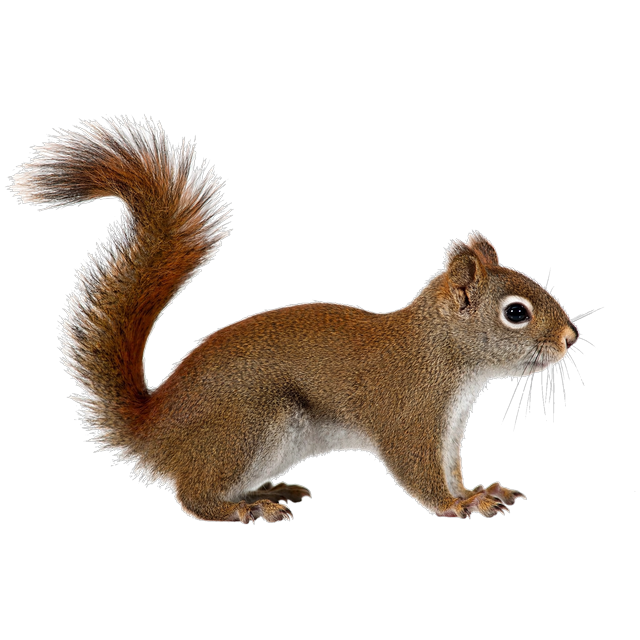
 Red squirrel
Tamiasciurus hudsonicus (Erxleben, 1777)
Red squirrel
Small, loud, and fiercely territorial, the forest's alarm system.
- Order
- Rodentia
- Family
- Sciuridae
- Group
- Wildlife
- Ontario status
- Native, common
Why it matters
Chews into cabins, cottages, and wood-sided homes; cone middens and noise; damages conifer seed crops.
Origin
Native across Canada's boreal and mixed forests; common in GTA ravines and wooded lots.
Behavior
Diurnal, solitary, aggressively territorial, chatters and foot-stomps at intruders ten times its size.
Living conditions
Middens (cone-scale piles) at the base of conifers; larder-hoards cones in one defended cache; active year-round.
Signs of presence
- Cone-scale middens under conifers
- Loud chattering and rattling calls
- Small gnawed holes at eaves
- Stripped conifer cones
Weaknesses
- Larder-hoarding concentrates activity at one midden, predictable
- Small size limits entry to gaps of about 4 cm and up
- Strictly territorial, one animal per territory, not colonies
Myths and facts
Myth Red squirrels are just baby gray squirrels.
Reality A separate, smaller species, adults weigh 200-250 g and never grow into gray squirrels.
Research notes
Morphology
Body 19-23 cm, tail 13-16 cm; weight 200-250 g. Rusty-red dorsum, white venter in winter, white eye-ring.
Diagnostics
Small size + red pelage + intense territorial vocalizations.
Easily confused with
- Gray squirrel (Sciurus carolinensis) Twice the size, gray, quieter; the red squirrel is the noisy one.
Life cycle
- Egg
- N/A, viviparous (placental mammal)
- Nymph or larva
- Pups: nest-bound about 8 weeks
- Adult
- Sexual maturity about 1 year; lifespan about 3 years wild
- Egg to adult
- Gestation about 38 days; weaning about 8 weeks
- Generations per year
- One litter per year (occasionally two in mast years)
Development
Altricial; weaned at about 8 weeks.
Reproduction
4-6 young × 1 litter/year.
Distribution
- Native range
- Canada and northern United States
- Ontario
- Native, common in forested and ravine habitat
- Global
- North America only
Ecology
Conifer specialist; larder-hoarder with a single defended midden; does not hibernate; territories about 0.5 ha.
Resistance
Unknown, not applicable.
IPM implications
Single-animal territories simplify the problem, one red squirrel, one territory. Exclude small gaps; the midden location reveals the resident. Licensed wildlife-control rules apply.
Chemical ecology
Urine and glandular scent-marking of territory boundaries; the loud 'rattle' vocalization is the primary territorial signal, acoustic, not chemical.
Genetics and DNA
No reference genome published as of 2026.
Taxonomy
Order Rodentia, family Sciuridae. Tamiasciurus hudsonicus (Erxleben, 1777).
Open questions
Mast-year population irruptions and their effect on human-wildlife conflict timing.
References
- Animal Diversity Web, Tamiasciurus hudsonicus species account (University of Michigan)
- Steele (1998), Tamiasciurus hudsonicus, Mammalian Species