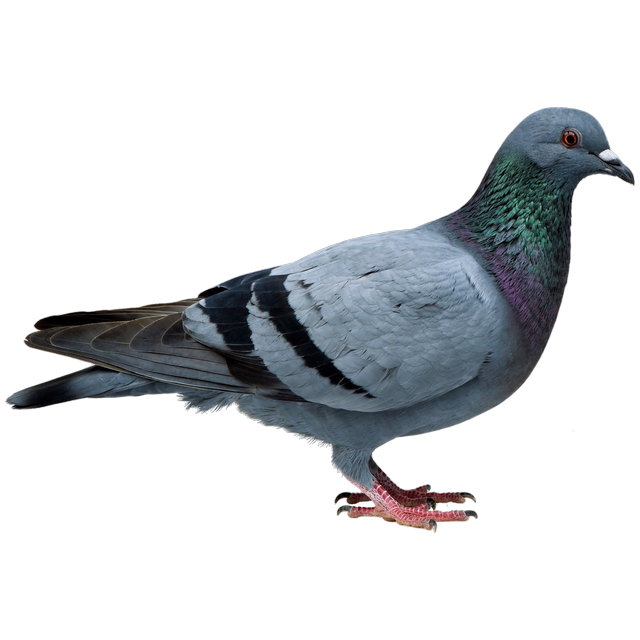
 Rock pigeon
Columba livia Gmelin, 1789
Rock pigeon
The cliff-dweller turned city-dweller, at home on every ledge downtown.
- Order
- Columbiformes
- Family
- Columbidae
- Group
- Birds
- Ontario status
- Established, ubiquitous urban
Why it matters
Droppings deface buildings and can harbor Histoplasma, Cryptococcus, and Chlamydia psittaci; nests clog drains; deep accumulations are a slip liability.
Origin
Native to sea cliffs of Europe, North Africa, and Asia; domesticated for millennia, then feral, the city is its artificial cliff.
Behavior
Diurnal; strong homing instinct; monogamous pairs; powerful fliers that commute kilometres to feeding sites.
Living conditions
Nests on ledges, eaves, signs, and bridges, any flat surface with overhead cover. Flocks where people feed them.
Signs of presence
- Whitewash droppings streaking ledges and facades
- Coarse stick nests on ledges, eaves, and signs
- Feather accumulation at roost sites
- Flocking and cooing on rooftops at dawn
Weaknesses
- Ledge-nester: netting and spikes remove the real estate it needs
- Flocks follow food, stop feeding and the flock disperses
- Nests are bulky and obvious, easy to find and address outside breeding
Myths and facts
Myth Pigeons are filthy disease spreaders.
Reality Documented risk is modest and tied to accumulated droppings in enclosed spaces, casual contact with a pigeon is not a health event. The real costs are structural and aesthetic.
Research notes
Morphology
Body 30-35 cm, wingspan 60-70 cm, weight 250-350 g. Wild type blue-grey with two dark wing bars and iridescent green-purple neck; feral plumage highly variable.
Diagnostics
Stocky columbid shape, small head, cooing call; wing bars and white rump patch in wild-type birds.
Easily confused with
- Mourning dove (Zenaida macroura) Mourning dove is slimmer with a long pointed tail and soft brown plumage; pigeons are stockier with fanning tails.
Life cycle
- Adult
- Lifespan 3-5 years wild; 15+ years in captivity
- Egg
- Clutch of 2; incubation 17-19 days, shared by both parents
- Egg to adult
- Hatch to fledging ~35 days
- Generations per year
- Year-round breeding; up to 6 broods/year
- Nymph or larva
- Squabs fledge at 30-37 days
Development
Oviparous; altricial squabs fed crop milk.
Reproduction
2 eggs per clutch × up to 6 broods/year.
Distribution
- Global
- Worldwide in human settlements
- Native range
- Cliffs of Europe, North Africa, and western Asia
- Ontario
- Established, ubiquitous in cities and towns
Ecology
Colonial cliff-nester turned urban exploiter; granivorous; strong site fidelity, pairs reuse nest sites for years.
Resistance
Unknown.
IPM implications
Exclusion is the entire strategy: netting, spikes, and ledge sloping remove nesting real estate. Food-source removal disperses flocks. Timing matters, work outside active nesting where possible, since nests with eggs or young engage wildlife regulations.
Chemical ecology
Uropygial (preen) gland secretions for feather maintenance; limited pheromonal communication.
Genetics and DNA
Reference genome published: Shapiro et al. 2013 (Science), rock pigeon reference genome; chromosome-level Shiqi pigeon assembly also available.
Taxonomy
Order Columbiformes › family Columbidae › Columba livia Gmelin, 1789. Feral populations derive from domestic stock.
Open questions
Feral population genetics and disease-carriage variation across Ontario cities are unstudied.
References
- Cornell Lab of Ornithology, Rock Pigeon (All About Birds)
- Internet Center for Wildlife Damage Management, Pigeons