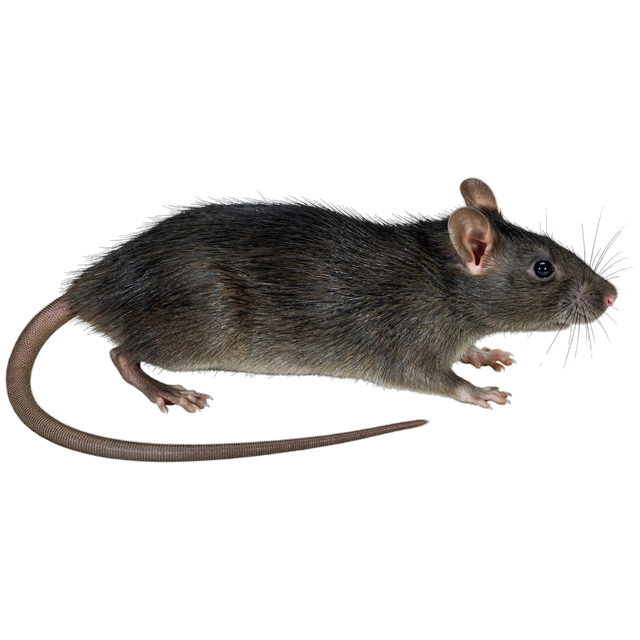
 Roof rat
Rattus rattus (Linnaeus, 1758)
Roof rat
The climbing rat, arboreal, agile, and at home in attics and rafters.
- Order
- Rodentia
- Family
- Muridae
- Group
- Rodents
- Ontario status
- Sporadic in Ontario, less cold-hardy than Norway rat
Why it matters
Contaminates stored food; damages structures and wiring in attics; the historical plague rat of medieval Europe.
Origin
Native to South and Southeast Asia; spread worldwide on ships, the classic ship rat of port cities.
Behavior
Nocturnal; arboreal and acrobatic. Less neophobic than the Norway rat, investigates new things sooner. An excellent climber.
Living conditions
Nests high: attics, rafters, trees, dense vines, and upper floors. Follows wires, branches, and fences as aerial highways.
Signs of presence
- Pointed droppings 10-12 mm in attics and along rafters
- Gnawed fruit, nuts, and pet food in elevated areas
- Nests of shredded material in attics and dense vegetation
- Nocturnal scurrying overhead
Weaknesses
- Arboreal habit concentrates signs in attics, inspect upward, not downward
- Less neophobic than Norway rats, so monitoring reads faster
- Cold-sensitive: Ontario winters limit its outdoor survival
Myths and facts
Myth Roof rats and Norway rats are the same animal.
Reality Different species, different habits: roof rats climb and nest high; Norway rats burrow and nest low. Tail longer than body = roof rat; shorter = Norway rat.
Research notes
Morphology
Body 160-200 mm, tail 190-250 mm (longer than head+body), weight 150-250 g. Sleek build, pointed muzzle, large ears. Droppings 10-12 mm, pointed or banana-shaped ends.
Diagnostics
Tail longer than body + pointed droppings 10-12 mm + elevated nesting sign. Sleeker and lighter than Norway rat at every age.
Easily confused with
- Norway rat (Rattus norvegicus) Norway rat is heavier with a blunt muzzle, tail shorter than body, and blunt droppings 12-18 mm.
Life cycle
- Adult
- Lifespan ~12 months in the wild
- Egg
- N/A, viviparous
- Egg to adult
- Gestation 21-23 days; maturity at 8-12 weeks
- Generations per year
- 4-6 (year-round in heated structures)
- Nymph or larva
- Pups weaned at ~21-28 days; mature at 8-12 weeks
Development
Viviparous; altricial.
Reproduction
6-8 pups per litter × 4-6 litters/year.
Distribution
- Global
- Cosmopolitan in warm regions; displaced by Norway rat in many temperate cities
- Native range
- South and Southeast Asia
- Ontario
- Sporadic, less cold-hardy than Norway rat; mostly port cities and heated structures
Ecology
Arboreal commensal; nests above ground in vegetation and structures; uses linear features (wires, limbs, fences) as travel routes; frugivorous tendency.
Resistance
Anticoagulant resistance documented in some populations globally; Ontario status unknown.
IPM implications
Inspection goes vertical: attics, rooflines, and tree limbs touching structures. Trim vegetation bridges; seal roofline gaps. Arboreal travel routes, wires, branches, vines, are the monitoring lines, not floor perimeters.
Chemical ecology
Urine and plantar-gland marking along aerial runways; colony scent at nest sites.
Genetics and DNA
Reference genome published: Rrattus_CSIRO_v1 (NCBI RefSeq Release 100); de novo assembly in Yu et al. 2022, Nature Communications.
Taxonomy
Order Rodentia › family Muridae › genus Rattus › R. rattus (Linnaeus, 1758). Also called the black rat or ship rat.
Open questions
Northern range limits in Ontario under warming winters are undocumented.
References
- UC IPM, Roof Rat (ipm.ucanr.edu)
- Internet Center for Wildlife Damage Management, Roof Rat