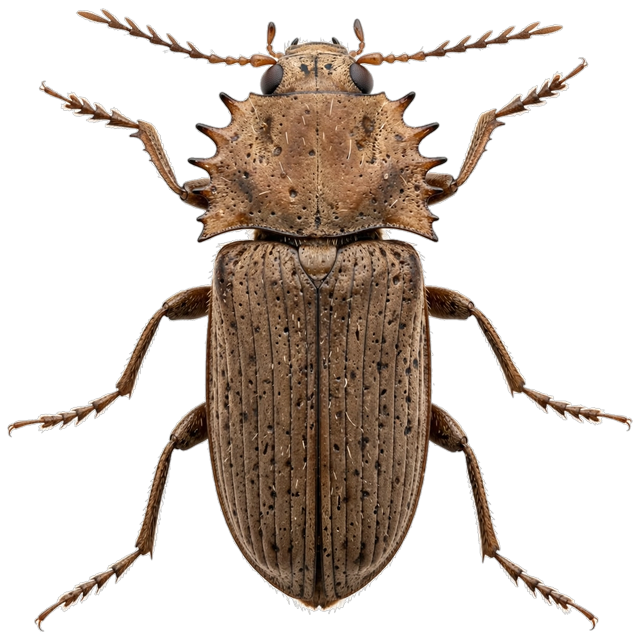
 Sawtoothed grain beetle
Oryzaephilus surinamensis (Linnaeus, 1758)
Sawtoothed grain beetle
A tiny flat beetle that slips into packaged food and cannot fly, if it's crawling on your cereal box, it's probably this one.
- Order
- Coleoptera
- Family
- Silvanidae
- Group
- Stored-product beetles
- Ontario status
- Established, cosmopolitan in heated food storage, mills, and retail across Ontario; cannot overwinter outdoors
Why it matters
One of the most common pantry pests in Ontario homes and a major pest of mills and food warehouses. Contamination, not bites or damage to structures, is the issue, infested product must be discarded.
Origin
Tropical in origin; now found everywhere humans store dry food. The name points to Suriname, where early specimens were described.
Behavior
Active year-round in heated buildings. Cannot fly, so it walks everywhere, infestations spread through contaminated product, not flight. Feeds on broken grains and processed foods rather than whole kernels.
Living conditions
Lives in dry stored foods, flour, cereal, pasta, pet food, dried fruit, nuts. The flat body lets it squeeze into unopened packages through tiny seams. Needs warmth; dies out in freezing Ontario winters outdoors.
Signs of presence
- Tiny brown beetles (2.5-3 mm) crawling on shelves, in cupboards, or on packaging
- Beetles inside sealed-looking boxes of cereal or flour
- A faint musty odor in heavily infested product
Weaknesses
- Cannot fly, containment is physical and effective
- Killed by freezing (below about -18 °C for several days)
- Cannot chew into intact whole kernels; depends on milled or damaged product
- Starves quickly without a food source, removing infested product ends most infestations
Myths and facts
Myth It ate through the sealed package.
Reality It almost never chews through packaging, it walks in through folds, seams, and imperfect seals. Truly sealed packaging defeats it.
Research notes
Morphology
2.5-3 mm, flattened, brown. Pronotum with six saw-like teeth on each lateral margin (the namesake). Elytra with longitudinal ridges. Flightless, hind wings reduced. Antennae gradually clubbed.
Diagnostics
Sawtooth pronotal margin + flightlessness separates it from the merchant grain beetle. Confirm under magnification: temple (behind eye) shorter than eye diameter in surinamensis.
Easily confused with
- Merchant grain beetle, Oryzaephilus mercator Merchant grain beetle flies; sawtoothed does not. Under magnification, the temple behind the eye is longer relative to eye size in mercator.
Life cycle
- Adult
- Long-lived, 6-10 months; feeds and reproduces continuously in warmth
- Egg
- Laid loosely in food; ~0.7 mm; hatch in ~1 week at 30 °C
- Egg to adult
- 4-8 weeks at 27-30 °C; several months at cool room temperature
- Generations per year
- 3-7 indoors depending on temperature
- Nymph or larva
- Larva: flattened, yellowish, ~3 mm at maturity; feeds 2-4 weeks; pupates in a cocoon of food particles
Development
Complete metamorphosis (holometabolous): egg → larva → pupa → adult.
Reproduction
Females lay ~200-300 eggs over the adult lifespan, deposited directly into the food.
Distribution
- Global
- Cosmopolitan in human food storage
- Native range
- Tropical Old World (exact origin uncertain)
- Ontario
- Established in heated storage provincewide; cannot overwinter outdoors
Ecology
Secondary pest of stored products, exploits cracked, milled, and processed commodities. Aggregation pheromones (macrolide cucujolides) concentrate populations in food patches.
Resistance
Phosphine resistance documented in stored-product populations in several regions; resistance levels lower than in lesser grain borer or red flour beetle but monitored in grain trade.
IPM implications
Sanitation is decisive: find and remove the infested product and the population collapses, because the beetle cannot fly to new resources easily and cannot penetrate intact packaging. Monitoring with pheromone-baited traps maps the infestation before product is discarded. Temperature (freezing) is a non-chemical option for salvageable goods.
Chemical ecology
Male-produced macrolide aggregation pheromones (cucujolides) attract both sexes to food; also responds to food volatiles.
Genetics and DNA
No reference genome published as of 2026.
Taxonomy
Order Coleoptera, family Silvanidae. Genus Oryzaephilus; the two stored-product species (surinamensis, mercator) are separated by flight ability and head/eye characters.
Open questions
Population genetics of global spread; interaction between phosphine resistance alleles and fitness in untreated refugia.
References
- Hagstrum, D.W. & Subramanyam, B. (2006). Fundamentals of Stored-Product Entomology. AACC International.
- Phillips, T.W. & Throne, J.E. (2010). Biorational approaches to managing stored-product insects. Annual Review of Entomology, 55:375-397.