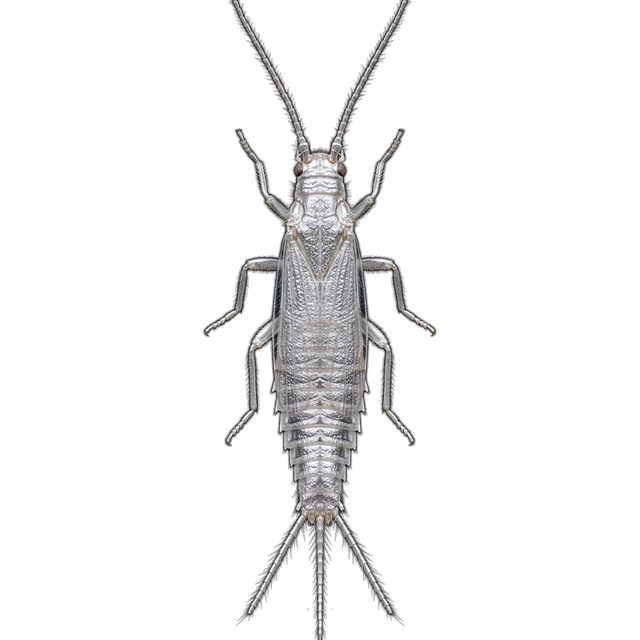
 Silverfish
Lepisma saccharinum Linnaeus, 1758
Silverfish
The silvery fish that eats your books, a humidity-loving relic that never grew wings.
- Order
- Zygentoma
- Family
- Lepismatidae
- Group
- Silverfish, firebrats & booklice
- Ontario status
- Established, common in damp basements, bathrooms, and attics
Why it matters
It damages books, wallpaper, and stored paper, a real nuisance for libraries, archives, and anyone with boxes in the basement. But it is harmless to people, and its presence is useful information: find the silverfish and you have found the damp spot.
Origin
Probably the Mediterranean region originally; now worldwide in human buildings.
Behavior
Nocturnal and shy, it bolts for cover when lights come on. Eats starches: book bindings, wallpaper paste, cereal boxes. It does not bite, sting, or spread disease.
Living conditions
Damp, cool, undisturbed places, basements, bathrooms, laundry rooms, attics with roof leaks, and boxes of old books and papers.
Signs of presence
- Surface feeding marks and irregular notches on book pages, wallpaper, or cereal boxes
- Yellowish stains on paper and fabrics
- Tiny pepper-like droppings near damaged paper
- The insect itself, darting for cover when you move a box at night
Weaknesses
- Needs humidity above ~75% to thrive, dry air is lethal over time
- Cannot fly, cannot jump, cannot bite; its only defense is running
- Slow to reproduce, a few dozen at a time, not thousands
- Completely dependent on undisturbed paper and starch stores; sealed containers starve it out
Myths and facts
Myth Silverfish mean my house is dirty.
Reality They mean your house is damp. Silverfish follow humidity, not filth, even spotless homes get them around a slow plumbing leak.
Research notes
Morphology
Body 12-19 mm; flattened, carrot/fish-shaped; covered in silvery scales; long antennae; three caudal filaments (two cerci + median filament). Wingless. Moves with a characteristic fish-like wiggle.
Diagnostics
Silvery, fish-shaped, wingless, three tail-like filaments, fish-like wriggling movement. Surface feeding damage on paper with irregular edges. Confirm humidity source nearby.
Easily confused with
- Firebrat (Thermobia domestica) Firebrats are mottled gray-brown and require heat; silverfish are uniformly silvery and prefer cool dampness.
- Jumping bristletails (Archaeognatha) Bristletails outdoors jump; silverfish cannot jump and are indoor species.
Life cycle
- Adult
- Adults live 2-8 years, exceptionally long for a small insect; keep molting for life
- Egg
- Eggs laid singly or in small groups in cracks; hatch in 2-8 weeks depending on humidity
- Egg to adult
- 3-4 months in warm damp conditions; up to a year when cool
- Generations per year
- Overlapping; continuous in heated buildings
- Nymph or larva
- Nymphs identical to adults in form, paler; many molts to maturity
Development
Ametabolous, no metamorphosis at all. Nymphs are miniature adults and the insect keeps molting throughout its entire adult life, unique among indoor pests.
Reproduction
Males deposit a spermatophore that the female picks up, indirect sperm transfer, primitive. Females lay ~100 eggs over a lifetime, a few at a time.
Distribution
- Global
- Cosmopolitan in human structures
- Native range
- Probably Mediterranean / subtropical Old World
- Ontario
- Established indoors province-wide; cannot overwinter outdoors
Ecology
Detritivore on starches, cellulose, and protein, paper, book bindings, wallpaper paste, cereals, dried foods. Nocturnal, thigmotactic, strongly hygrophilic. Among the most primitive living insects (Zygentoma).
Resistance
Unknown, managed physically; no documented resistance.
IPM implications
Monitoring: sticky traps in damp zones index the population. Management is climate and storage: dehumidify below 50%, store books and papers in sealed containers, fix leaks, declutter. The silverfish is the messenger, its presence maps the damp microhabitats. Chemical control is rarely justified and fails without moisture correction.
Chemical ecology
No venom; aggregation is mediated by species-specific contact (arrestment) pheromones rather than long-range attractants (Woodbury & Gries, 2007). Aggregation is thigmotactic and humidity-driven.
Genetics and DNA
No reference genome published as of 2026.
Taxonomy
Order Zygentoma, family Lepismatidae. Authority (Linnaeus, 1758). Among the most basal insect lineages, a living fossil in the basement.
Open questions
Population genetics of indoor populations; exact nutritional ecology in modern buildings.
References
- Ebeling, W. (1978). Urban Entomology, University of California, Riverside.