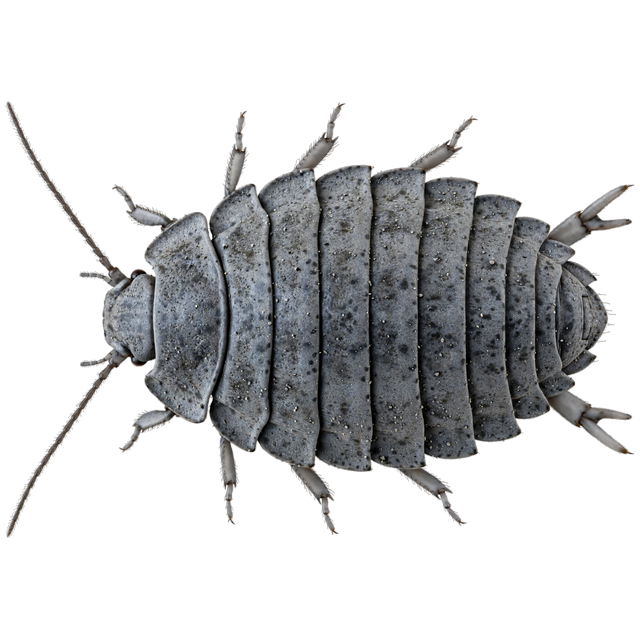
 Sowbug
Porcellio scaber Latreille, 1804
Sowbug
A land-dwelling crustacean, not an insect, that needs damp places to survive.
- Order
- Isopoda
- Family
- Porcellionidae
- Group
- Occasional invaders
- Ontario status
- Established, common
Why it matters
A nuisance and a moisture indicator. Sowbugs indoors signal damp conditions that can also support mold, silverfish, and other moisture pests. They damage nothing and threaten no one.
Origin
Native to Europe; now cosmopolitan, one of the most widespread terrestrial crustaceans on earth, and long established in Ontario.
Behavior
A nocturnal scavenger that feeds on decaying leaves, wood, and organic matter. Cannot roll into a ball, its body is too flat (unlike its cousin the pillbug). Harmless: no bite, no sting, no venom.
Living conditions
Needs constant moisture. It breathes through gill-like structures under its abdomen, so dry air kills it. Outdoors it lives under logs, stones, leaf litter, mulch, and doormats; indoors it appears in damp basements, bathrooms, and ground-level rooms.
Signs of presence
- Small gray oval creatures under doormats, planters, and stored items
- Sightings in damp basements, laundry rooms, and bathrooms
- Clusters under logs, stones, or mulch near the foundation
- Most active at night or after rain
Weaknesses
- Desiccation, remove moisture and it cannot survive
- Ground-level harborages: leaf litter, mulch against the foundation, boards, stones
- Entry gaps at ground level: door sweeps, foundation cracks, weep holes
Myths and facts
Myth Sowbugs are insects.
Reality They are terrestrial crustaceans, relatives of crabs and shrimp. They have seven pairs of legs and breathe with gills.
Myth They infest homes the way cockroaches do.
Reality They cannot breed in dry indoor conditions. Indoor sightings are wanderers from outside that die without moisture.
Research notes
Morphology
Adults 8-15 mm long, 4-6 mm wide; dorsoventrally flattened oval body of seven pereon segments; slate-gray with a rough, granular dorsal surface; two pairs of antennae (one pair minute); seven pairs of walking legs; uropods project visibly beyond the rear margin.
Diagnostics
Flat (not convex) profile that cannot conglobate; granular dorsal texture; uropods extending past the telson. Distinguished from Armadillidium by the flattened body and inability to roll into a ball.
Easily confused with
- Pillbug, Armadillidium vulgare The pillbug is convex and rolls into a complete ball; the sowbug is flat and cannot.
Life cycle
- Adult
- Lives 2-3 years; 1-3 broods per year, roughly 20-50 young per brood
- Egg
- Carried 3-4 weeks in the female's marsupium
- Egg to adult
- Several months, temperature-dependent
- Generations per year
- 1-2 outdoors in Ontario
- Nymph or larva
- Mancae; about 5 molts to maturity over several months
Development
Direct development, no metamorphosis. Eggs carried in a ventral brood pouch (marsupium); young hatch as mancae and gain the seventh leg pair after the first molt.
Reproduction
Sexual reproduction; females brood fertilized eggs in the marsupium until hatching. Brood size roughly 20-50.
Distribution
- Global
- Cosmopolitan in temperate regions worldwide
- Native range
- Europe
- Ontario
- Established, common province-wide in leaf litter, gardens, and damp structures
Ecology
Detritivore and key decomposer of leaf litter and decaying wood. Aggregates in moist microhabitats via thigmotaxis and humidity response; activity peaks at night and after rain. Prey for ground beetles, centipedes, and spiders.
Resistance
Unknown, not a pesticide target; no documented resistance.
IPM implications
Moisture management is the entire strategy: fix leaks, ventilate crawlspaces, grade soil away from the foundation, and remove ground-contact harborages (mulch, boards, leaf litter) within a meter of the building. Exclusion at ground level, door sweeps, sealed weep holes, foundation crack repair, stops indoor wanderers. Indoor sightings are a diagnostic signal for dampness, not a breeding population.
Chemical ecology
Aggregation is driven by touch (thigmotaxis) and moisture gradients rather than long-range pheromones; no defensive chemistry of note.
Genetics and DNA
No reference genome published as of 2026.
Taxonomy
Order Isopoda, suborder Oniscidea (woodlice), family Porcellionidae. Porcellio scaber Latreille, 1804.
Open questions
Population genetics of introduced North American lineages are poorly mapped; desiccation-tolerance thresholds across populations are understudied.
References
- Penn State Extension, Sowbugs and Pillbugs
- University of Minnesota Extension, Sowbugs and pillbugs in the home
- NC State Extension, Woodlice: sowbugs and pillbugs