 Spotted-wing drosophila
Drosophila suzukii Matsumura, 1931
Spotted-wing drosophila
An invasive fruit fly whose females slice into healthy, ripening berries and cherries to lay eggs.
- Order
- Diptera
- Family
- Drosophilidae
- Group
- Flies
- Ontario status
- Established, invasive, expanding
Why it matters
A major agricultural pest of Ontario's berry and tender-fruit industries, significant crop losses. A home-garden nuisance, not a health threat.
Origin
Native to Southeast Asia; invaded North America in 2008 and reached Ontario within a few years.
Behavior
Active in orchards, berry farms and gardens from summer into autumn. Females cut the fruit skin with a saw-like egg-laying organ; larvae develop inside the fruit.
Living conditions
Breeds in ripening and ripe soft fruit, berries, cherries, grapes, plus wild hosts like buckthorn and honeysuckle. Unlike common fruit flies, it does not need damaged or rotting fruit.
Signs of presence
- Tiny flies with spotted wings around berry plantings in late summer
- Berries collapsing with tiny white larvae inside
- Sunken spots on cherry and berry skins
Weaknesses
- Needs ripening fruit, sanitation (removing fallen and overripe fruit) breaks the cycle
- Cold winters kill many; it re-establishes from survivors and wild hosts
- Fine-mesh exclusion netting protects high-value crops
- Traps with fermentation baits monitor the invasion front
Myths and facts
Myth It's just the regular fruit fly from my kitchen.
Reality It looks similar but behaves oppositely: the kitchen fruit fly needs rotting fruit, while this invader attacks healthy ripening fruit on the plant.
Research notes
Morphology
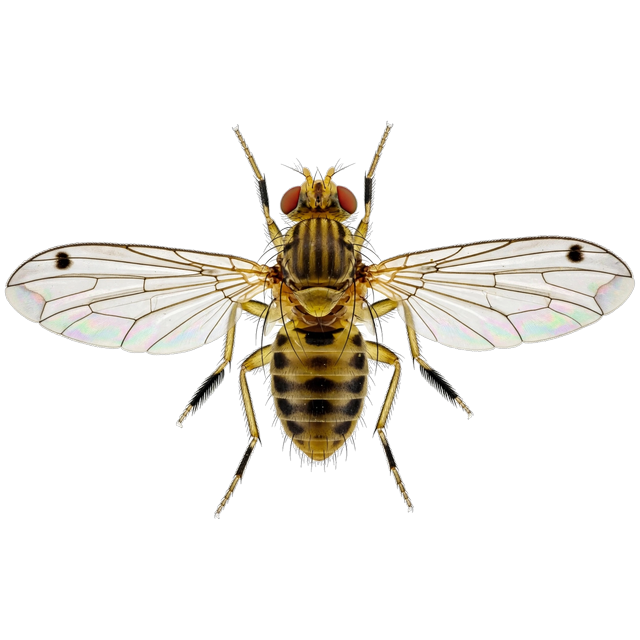
Adult 2-3 mm; tan-yellow body. Males: a dark spot on the leading edge of each wing, the field diagnostic. Females: enlarged, serrated ovipositor (visible under magnification) for cutting fruit skin. Red eyes as in D. melanogaster.
Diagnostics
Confirm by: 2-3 mm drosophilid, male wing spots, female serrated ovipositor, association with ripening (not rotting) fruit.
Easily confused with
- Fruit fly, Drosophila melanogaster D. melanogaster lacks wing spots and the serrated ovipositor, and only uses damaged or fermenting fruit; D. suzukii uses intact ripening fruit.
Life cycle
- Egg
- Inserted under the skin of ripening fruit via the serrated ovipositor
- Nymph or larva
- Larvae feed inside the fruit, causing collapse; 3 instars
- Adult
- Overwinters as adults in sheltered sites (winter morph with darker coloration); active spring to late autumn
- Egg to adult
- Approximately 1-2 weeks at 25 °C; longer in cool weather
- Generations per year
- Up to 10+ per year, the engine of its invasiveness
Development
Complete metamorphosis: egg → larva (3 instars, inside fruit) → pupa → adult.
Reproduction
Females lay eggs in healthy ripening fruit, an effectively unlimited resource compared to the rotting-fruit niche of its relatives.
Distribution
- Native range
- Southeast Asia
- Ontario
- Established since the early 2010s; annual pressure on berry and cherry crops
- Global
- Asia, Europe, North and South America, a global invader
Ecology
Wild hosts (buckthorn, honeysuckle, wild blackberry) sustain populations between crop seasons. Overwintering adults re-invade crops each summer. Range still expanding northward with climate.
Resistance
Insecticide resistance documented in some populations (spinosyns, pyrethroids), an active research area given heavy spray reliance in berries.
IPM implications
The serrated ovipositor rewrites the playbook: unlike kitchen fruit flies, sanitation must target ripening and fallen fruit, not just rot. Monitoring with apple-cider-vinegar traps tracks the seasonal invasion; exclusion netting is the most reliable non-chemical tool; harvest timing (early, complete) denies late-season generations. Spray programs exist in agriculture but face the documented resistance trajectory.
Chemical ecology
Attracted to ripening-fruit volatiles and fermentation cues; oviposition choice follows fruit firmness, sugar content and skin penetration resistance.
Genetics and DNA
Draft genome published 2013 (Ometto et al., G3), genomics actively used to study its invasion biology.
Taxonomy
Diptera: Drosophilidae. Drosophila suzukii (Matsumura, 1931). A drosophilid that broke the family's rotting-fruit rule.
Open questions
Northern overwintering limits under climate change; the role of wild hosts in re-infestation dynamics in Ontario.
References
- Ometto et al. (2013), G3, Drosophila suzukii genome
- Asplen et al. (2015), Journal of Pest Science, global invasion review
- Ontario Ministry of Agriculture, spotted-wing drosophila monitoring and management