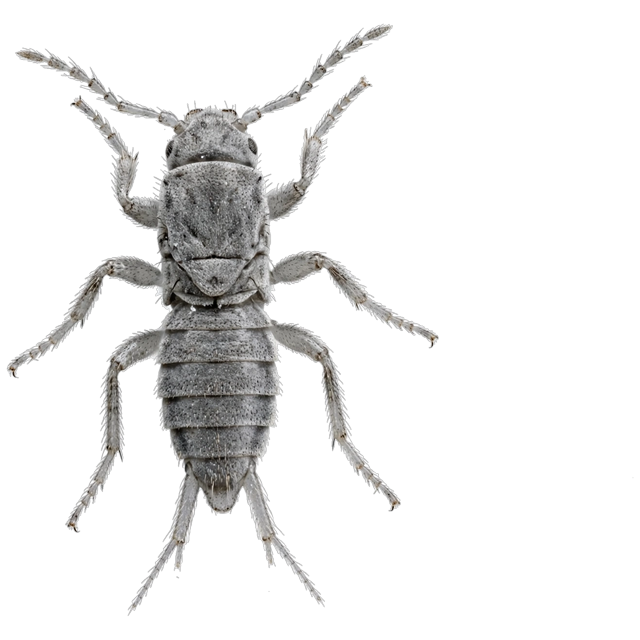
 Springtail
Collembola
Springtail
The microscopic jumper in your potted plant, a sign of wet soil, not an infestation.
- Order
- Collembola
- Family
- Various
- Group
- Occasional invaders
- Ontario status
- Native and ubiquitous, soil, leaf litter, and damp indoor spots
Why it matters
Springtails are the most honest moisture meter in the building, and completely harmless. A bloom in your plants means you're overwatering; a bloom in the basement means water is getting in. Listen to them.
Origin
Everywhere, among the oldest and most abundant land animals on Earth.
Behavior
Grazes on mold and decaying matter in wet soil, launching itself with a spring-loaded tail when disturbed. Cannot bite, cannot damage anything.
Living conditions
Wet potted-plant soil, damp basements, drains with biofilm, saturated mulch, anywhere that never quite dries out.
Signs of presence
- Tiny gray specks that jump when you water a houseplant
- 'Moving dust' on damp basement floors or in drains
- Masses on the surface of saturated potting soil
- Numbers that explode after overwatering
Weaknesses
- Dies quickly in dry conditions, drying the soil erases them
- Cannot bite, infest, or damage anything in the home
- Confined to the wet spot; they cannot spread through a dry house
- The fix is always the same: find the water and remove it
Myths and facts
Myth The tiny jumping things are fleas infesting my home.
Reality Fleas bite and need a blood host; springtails can't bite at all and need only wetness. If it jumps in your plant soil and doesn't bite, it's a springtail.
Research notes
Morphology
1-3 mm; soft-bodied; gray, white, or purple; six legs; the furcula (forked tail) folded under the abdomen powers the jump. Visible as 'jumping dust' on wet soil.
Diagnostics
1-3 mm soft pale hexapods that jump when disturbed, in damp soil, drains, or potted plants. The furcula snap is diagnostic. Confirm chronic moisture at the site.
Easily confused with
- Fleas (Siphonaptera) Fleas are laterally flattened, dark, hard-bodied biters; springtails are soft, pale, non-biting, and jump via a visible tail fork.
Life cycle
- Adult
- Adults keep molting and reproducing for months
- Egg
- Eggs laid in damp organic matter
- Egg to adult
- Weeks in warm damp conditions
- Generations per year
- Continuous while moist
- Nymph or larva
- Juveniles are miniature adults
Development
Ametabolous-ish, direct development with continued molting through life (like silverfish). Populations track moisture, not season.
Reproduction
Parthenogenetic in some species; enormous reproductive rate in saturated organic matter.
Distribution
- Global
- Among the most abundant animals on Earth, Antarctic to tropics
- Native range
- Worldwide; ancient lineage
- Ontario
- Ubiquitous in soil and leaf litter; indoor populations wherever it stays damp
Ecology
Keystone soil decomposers, among the most numerous arthropods on the planet, grazing fungi and decaying matter. Indoor occurrences are spillover from saturated microhabitats, never true infestations.
Resistance
Not applicable, not a pesticide target.
IPM implications
The purest moisture-indicator on this list: springtails indoors mean chronic dampness, overwatered plants, leaking pipes, saturated mulch, drain biofilm. Fix the water and they vanish without any treatment. Let potted-plant soil dry between waterings. Never a chemical case.
Chemical ecology
No venom, no notable chemistry; the furcula (springing organ) is mechanical, a catapult latched under the abdomen. Some species are pigmented; most are cryptic.
Genetics and DNA
Reference genomes exist for springtails: Folsomia candida (221.7 Mb, Faddeeva-Vakhrusheva et al., BMC Genomics 2017) and Orchesella cincta, among others.
Taxonomy
Order Collembola (sometimes ranked as class), ancient hexapods, not true insects. Multiple families occur in Ontario buildings and soils.
Open questions
Ontario indoor species inventory; their role as early indicators of building moisture failure deserves formal study.
References
- Hopkin, S.P., Collembola biology literature (various).
- Ebeling, W. (1978). Urban Entomology, University of California, Riverside.