 Stored-product mite
Tyrophagus putrescentiae (Schrank, 1781)
Stored-product mite
The 'mite dust' in your old flour, a sign the food went damp, not a sign of a dirty kitchen.
- Order
- Sarcoptiformes
- Family
- Acaridae
- Group
- Ticks & mites
- Ontario status
- Established, pantries, grain storage, anywhere food meets moisture
Why it matters
It contaminates stored food and its dust is allergenic, but it is really a moisture alarm. Finding mold mites means finding the damp package, the leaky shelf, or the humid pantry, and fixing that fixes everything.
Origin
Wherever humans store food, as old as granaries.
Behavior
Eats mold on damp stored food and multiplies explosively, a forgotten bag of flour in a humid pantry can hold millions. The fine 'dust' on the food surface is the mites themselves.
Living conditions
Pantries, pet food bags, bird seed, grain bins, anywhere dry goods have absorbed moisture and started to mold.
Signs of presence
- A fine dust on flour, cereal, or pet food that seems to move when you stare at it
- A faint sweet or minty odor from heavily infested grain
- Mold visible in the same package
- Itching or allergy symptoms when handling old stored products
Weaknesses
- Cannot survive in dry food, below about 13% moisture the population collapses
- Dies with the mold it feeds on; remove damp goods and it has nothing to eat
- Cannot travel far on its own; it arrived in the package
- Vulnerable to freezing and to thorough HEPA vacuuming of the shelf
Myths and facts
Myth Mite dust means my kitchen is filthy.
Reality It means one package got damp. The mites came with the food or the moisture, not with poor housekeeping, even clean pantries get them in a humid summer.
Research notes
Morphology
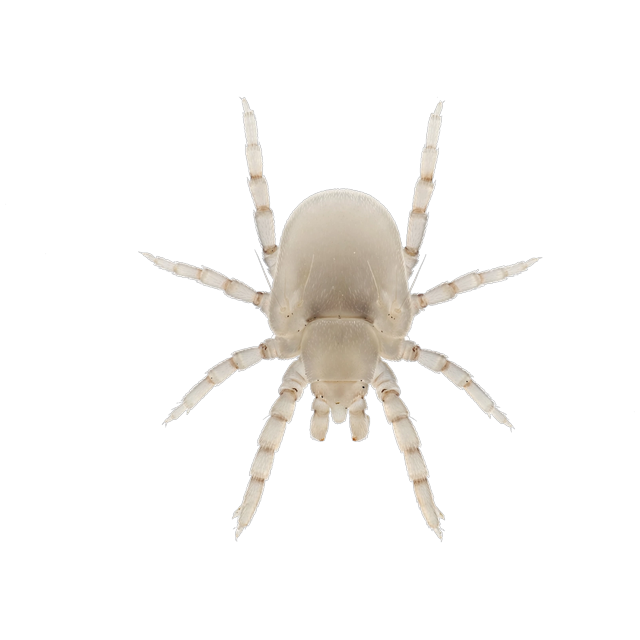
0.3-0.5 mm; pale, pear-shaped, with long hairs; eight legs. Visible as shimmering 'dust' that moves when watched closely.
Diagnostics
Moving 'dust' on stored food, confirmed by microscopy. Often found with visible mold, the mold is the actual food source. Check moisture content of the commodity.
Easily confused with
- House dust mite (Dermatophagoides spp.) Dust mites live on skin flakes in bedding; mold mites live on damp food and grain. Location is the separator.
Life cycle
- Adult
- Adults live weeks; females lay hundreds of eggs
- Egg
- Eggs laid in the food mass; hatch in days in warmth
- Egg to adult
- About 1 week at 25 C and high humidity; weeks when cool or dry
- Generations per year
- Continuous while conditions allow
- Nymph or larva
- Larva plus up to three nymphal stages; the hypopus stage disperses on insects
Development
Egg to larva to protonymph to deutonymph (sometimes a non-feeding dispersal hypopus) to tritonymph to adult. As fast as ~1 week in warm humid grain.
Reproduction
Enormous reproductive rate in warm humid food, populations explode from a few founders in weeks.
Distribution
- Global
- Worldwide in stored products
- Native range
- Cosmopolitan with stored food
- Ontario
- Pantries, warehouses, and grain handling province-wide
Ecology
Mycophagous detritivore, it eats the mold growing on damp stored food, not the food itself. Its presence is a moisture diagnostic: dry commodities do not support it. Also infests aged cheese and cured meats.
Resistance
Unknown, managed by sanitation; no documented resistance.
IPM implications
Discard infested goods (sealed bag, out of the building), then fix the moisture, the mites are the symptom. Clean with HEPA vacuuming; inspect neighboring packages. In commercial storage, moisture monitoring and stock rotation prevent recurrence. This is sanitation and climate control, not chemistry.
Chemical ecology
Feeds on fungi and detritus; produces the allergenic 'mite dust.' Some populations carry a dispersing deutonymph stage (hypopus) adapted to hitchhiking on insects.
Genetics and DNA
No reference genome published as of 2026.
Taxonomy
Order Sarcoptiformes, family Acaridae. Authority (Schrank, 1781). Also called the mold mite or cheese mite; Tyrophagus is a large genus of stored-food acarids.
Open questions
Strain-level differences in commodity preference; hypopus dispersal ecology in buildings.
References
- Krantz, G.W. & Walter, D.E. (2009). A Manual of Acarology, 3rd ed., Texas Tech University Press.
- Ebeling, W. (1978). Urban Entomology, University of California, Riverside.