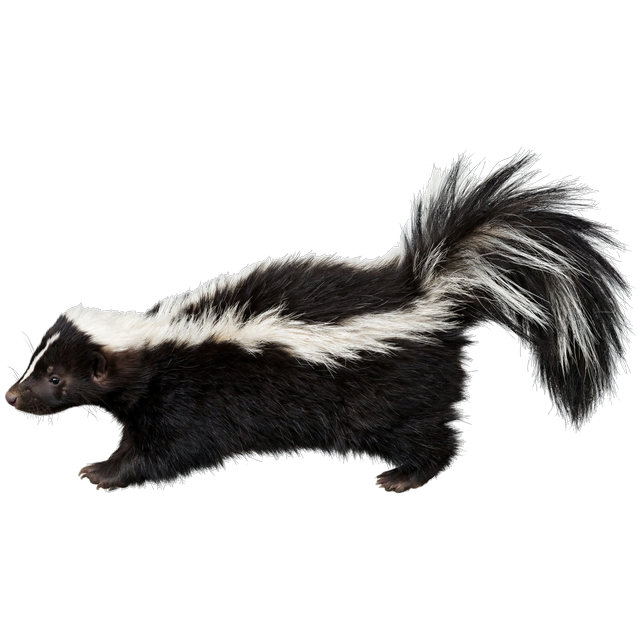
 Striped skunk
Mephitis mephitis (Schreber, 1776)
Striped skunk
The black-and-white chemist, warns first, sprays second.
- Order
- Carnivora
- Family
- Mephitidae
- Group
- Wildlife
- Ontario status
- Native, common; rabies vector species
Why it matters
Lawn damage, pet-spraying incidents, denning under structures, and rabies-vector status in Ontario.
Origin
Native across North America; common in GTA suburbs wherever lawns meet ravines.
Behavior
Nocturnal and docile, gives a full warning sequence (foot-stamping, tail-raising, handstand) before spraying; poor eyesight, strong sense of smell.
Living conditions
Dens under decks, porches, sheds, and woodpiles; digs for grubs in lawns; active spring to autumn, dormant through deep winter.
Signs of presence
- Small cone-shaped holes about 8 cm wide dug in lawns (grub hunting)
- Musky odour near decks or sheds
- Five-toed tracks with long claw marks
- Warning display: foot-stamping and tail-up posture
Weaknesses
- Spray is a last resort, the warning display gives time to back away
- Dormant in winter cold, den sites are occupied but quiet
- Poor climber, intact fencing is an effective barrier
Myths and facts
Myth Skunks spray constantly and without warning.
Reality Spraying depletes a limited reserve that takes days to rebuild, a skunk warns repeatedly first and would rather not waste it.
Research notes
Morphology
Body 33-45 cm, tail 18-25 cm; weight 2-6 kg (males larger). Black pelage with white dorsal stripes (pattern variable); short legs, long foreclaws for digging.
Diagnostics
Striped pattern + waddling plantigrade gait + musk odour; tracks show five toes with prominent claw marks.
Easily confused with
- Raccoon (Procyon lotor) Larger, masked face, ringed furred tail, no stripes; climbs well, skunks do not.
- Domestic cat (sightings at dusk) Cat tracks lack claw marks and the skunk's waddle; striping and body proportions differ on close inspection.
Life cycle
- Egg
- N/A, viviparous (placental mammal)
- Nymph or larva
- Kits: den-bound about 6 weeks
- Adult
- Sexual maturity about 1 year; lifespan about 3 years wild
- Egg to adult
- Gestation about 63 days; weaning about 2 months
- Generations per year
- One litter per year (February, March breeding)
Development
Kits born blind; eyes open at about 3 weeks; follow the mother in single file by 6-7 weeks.
Reproduction
4-6 kits per litter (range 2-10) × 1 litter/year.
Distribution
- Native range
- North America, from southern Canada to northern Mexico
- Ontario
- Native, common across southern and central Ontario
- Global
- Not established outside North America
Ecology
Dens in self-dug or repurposed burrows and under structures; winter dormancy with communal denning and periodic arousal, not true hibernation. Omnivore: grubs, insects, eggs, fruit.
Resistance
Unknown, not applicable; no chemical-control context for a native mammal.
IPM implications
Grub-damaged lawns are the attractant, the skunk is a symptom of a grub population. Exclusion under decks and porches targets denning; winter is the low-activity window for structural work. Rabies-vector species: any bite or pet contact is a public-health matter. Wildlife control licensing applies (Fish and Wildlife Conservation Act).
Chemical ecology
Anal-gland secretion: sulfur-containing thiols, (E)-2-butene-1-thiol and thioacetates, among the most pungent mammalian secretions; atomized and aimed, about 3-5 m range. Thioacetates hydrolyze to thiols on contact with water, which is why the smell 'reactivates' when wet.
Genetics and DNA
No reference genome published as of 2026.
Taxonomy
Order Carnivora, family Mephitidae, moved out of Mustelidae on molecular evidence. Mephitis mephitis (Schreber, 1776).
Open questions
Individual variation in musk chemistry and its role in individual recognition is not fully characterized.
References
- Animal Diversity Web, Mephitis mephitis species account (University of Michigan)
- Rosatte & Lariviere (2003), skunks chapter in Wild Mammals of North America, 2nd ed.