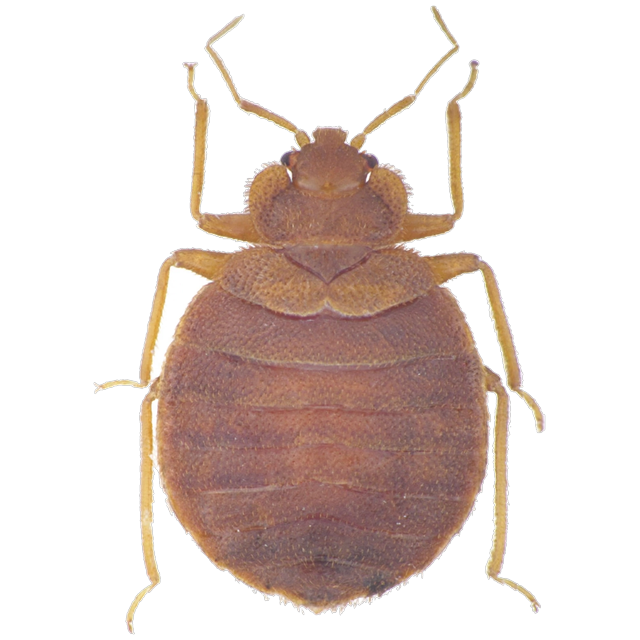
 Swallow bug
Oeciacus vicarius Horváth, 1912
Swallow bug
The bird-nest cousin of the bed bug, it moves indoors when the swallows fly south.
- Order
- Hemiptera
- Family
- Cimicidae
- Group
- Bed bugs & relatives
- Ontario status
- Occurs with swallow nesting on buildings; sporadic indoor records
Why it matters
Bites people when its bird hosts migrate, causing itchy welts. Like the bat bug, the source is the nest, treating the bedroom alone misses it.
Origin
Native to North America, living in the mud nests of swallows (especially cliff swallows) for as long as swallows have nested on buildings. Its Eurasian counterpart is Oeciacus hirundinis.
Behavior
Feeds on nesting birds. When the birds leave, hungry bugs wander through wall voids and vents into rooms below the nests.
Living conditions
Lives in swallow nests under eaves, in barns and on building ledges. Enters homes in late summer and fall when swallows migrate and the nests go quiet.
Signs of presence
- Bed-bug-like insects appearing in late summer/fall in rooms below eaves
- Swallow nests on the building exterior above the affected rooms
- Bugs near vents, upper walls and ceilings rather than beds
Weaknesses
- Depends on active bird nests, no nests, no population
- Seasonal, tied to the swallows' calendar
- Cannot fly; enters only through connected voids
Myths and facts
Myth Any small biting bug in fall is a bed bug.
Reality Swallow bugs surge when birds migrate; the calendar and the nests overhead are the diagnostic clues.
Research notes
Morphology
4-5 mm, oval, reddish-brown, wingless, morphologically very close to Cimex lectularius and C. pilosellus. Separation from bed/bat bugs is primarily ecological (host association) plus subtle chaetotaxy; microscopic examination advised.
Diagnostics
Confirm by association with swallow nests on the structure + seasonal timing (post-migration) + cimicid morphology. Host ecology is the practical separator.
Easily confused with
- Bed bug, Cimex lectularius Morphologically near-identical; swallow bugs associate with bird nests on buildings and surge after swallow migration, bed bugs associate with sleeping hosts year-round.
- Bat bug, Cimex pilosellus Bat bugs associate with bat roosts; swallow bugs with bird nests. Both are diagnosed ecologically as much as morphologically.
Life cycle
- Adult
- Adults survive months; overwinter in nests without hosts.
- Egg
- ~1 mm eggs laid in nest crevices.
- Egg to adult
- Weeks to months depending on temperature and host availability
- Generations per year
- Tied to the swallow nesting season
- Nymph or larva
- 5 nymphal instars requiring blood meals (normally avian).
Development
Incomplete metamorphosis: egg → nymph → adult.
Reproduction
Traumatic insemination as in Cimex; reproduction concentrated in the bird nesting season.
Distribution
- Global
- North America, wherever swallows nest on structures (the Eurasian O. hirundinis is Holarctic)
- Native range
- North America
- Ontario
- Occurs where swallows nest on buildings; sporadic indoor records in late summer/fall, and again in late winter/spring as overwintered bugs stir before the swallows return
Ecology
Obligate associate of swallows (barn swallow, cliff swallow) nesting on structures. Overwinters unfed in nests. Disperses into buildings via voids and vents when hosts depart.
Resistance
No published data.
IPM implications
Source reduction is nest-focused: inspect eaves, ledges and vents for active or recent swallow nests when cimicids appear seasonally. Note that swallows are protected (migratory bird regulations), nest management must follow wildlife law. Sealing the building envelope at the nest interface prevents ingress.
Chemical ecology
Not well characterized; presumed similar to Cimex lectularius.
Genetics and DNA
No reference genome published as of 2026.
Taxonomy
Order Hemiptera, family Cimicidae, genus Oeciacus. Described by Horváth, 1912. North American swallow associate; the Eurasian congener is Oeciacus hirundinis (formerly Cimex hirundinis Lamarck, 1816).
Open questions
Extent of human-host feeding vs. incidental biting; overwintering survival in Ontario nests.
References
- Mallis Handbook of Pest Control
- Potter, M.F. University of Kentucky Entomology extension (cimicid biology)