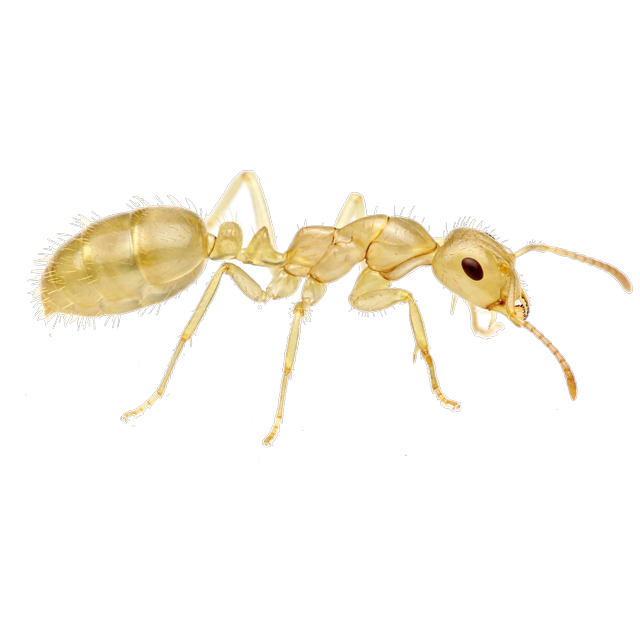
 Thief ant
Solenopsis molesta (Say, 1836)
Thief ant
A 1.5 mm yellow burglar that nests beside other ant colonies and steals their food and young.
- Order
- Hymenoptera
- Family
- Formicidae
- Group
- Ants
- Ontario status
- Native, established provincewide
Why it matters
A food contaminator that defeats packaging, its minute size lets it enter where larger ants cannot. Also complicates identification, since it is often found alongside the 'main' ant species.
Origin
Native to North America; named for its habit of robbing neighboring ant nests.
Behavior
Forages in faint trails, mostly at night. Workers are so small they can enter sealed food packaging through tiny gaps.
Living conditions
Nests in soil, under objects, in wall voids and near other ant colonies, often connected to them by tiny tunnels. Also nests in potted plants and food packaging areas.
Signs of presence
- Extremely tiny yellow ants in kitchens, often near other ant activity
- Ants inside sealed food packages
- Fine soil excavations in potted plants
Weaknesses
- Colonies are small and nests are shallow
- Foraging trails, though faint, lead to the nest
- Needs moisture, dry sites exclude it
Myths and facts
Myth Tiny yellow ants are always pharaoh ants.
Reality Thief ants are equally tiny and yellow; antenna structure separates them, a hand lens matters.
Research notes
Morphology
Workers 1.3-1.8 mm, pale yellow. 10-segmented antennae with 2-segmented club (key character). Two-segmented waist; no propodeal spines. Workers monomorphic.
Diagnostics
Confirm by minute size + 10-segmented antennae with 2-segmented club + association with other ant nests or wall voids.
Easily confused with
- Pharaoh ant, Monomorium pharaonis Pharaoh ant has 12-segmented antennae with a 3-segmented club; thief ant has 10-segmented antennae with a 2-segmented club.
Life cycle
- Adult
- Workers live ~1-2 months; queens longer.
- Egg
- Eggs hatch in ~2 weeks at warm temperatures.
- Egg to adult
- ~30-50 days depending on temperature
- Generations per year
- Multiple; continuous in heated buildings
- Nymph or larva
- Legless larvae; naked pupae.
Development
Complete metamorphosis: egg → larva → pupa → adult.
Reproduction
Multiple queens; colonies small to moderate (hundreds to a few thousand workers).
Distribution
- Global
- North America
- Native range
- North America
- Ontario
- Native; established provincewide
Ecology
Lestobiotic, nests adjacent to other ant species and raids their brood and food stores via minute tunnels. Also independent nests in soil, wall voids and pots. Omnivorous.
Resistance
No published data.
IPM implications
Because it nests beside other ant species, finding thief ants should trigger inspection for a second, larger host colony nearby. Its minute size means monitoring needs magnification, trails are easily missed. Sealing and packaging integrity matter more than for larger ants.
Chemical ecology
Not well characterized; recruitment pheromones presumed as in related Solenopsis.
Genetics and DNA
No reference genome published as of 2026.
Taxonomy
Order Hymenoptera, family Formicidae, subfamily Myrmicinae, genus Solenopsis (same genus as fire ants). Described by Say, 1836.
Open questions
Frequency of lestobiosis vs. independent nesting in structures; host-species preferences in Ontario.
References
- Hölldobler, B. & Wilson, E.O. 1990, The Ants, Harvard University Press
- Mallis Handbook of Pest Control