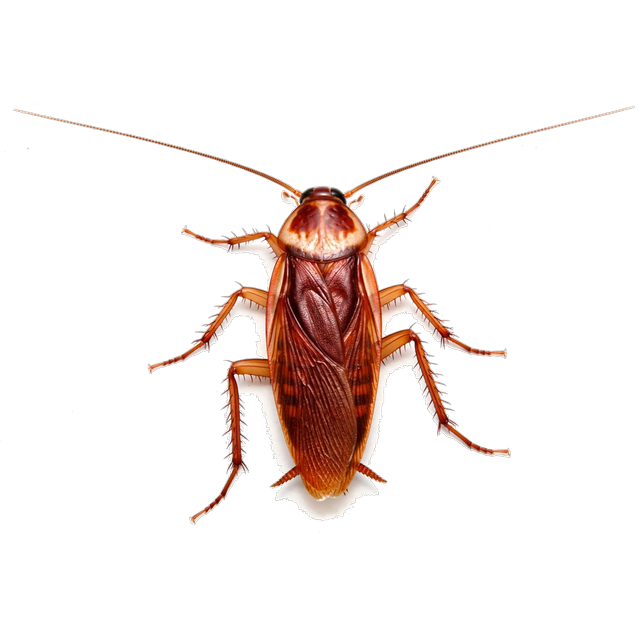
 Turkestan cockroach
Shelfordella lateralis (Walker, 1868)
Turkestan cockroach
A reddish-brown cockroach spreading through the southwestern US.
- Order
- Blattodea
- Family
- Blattidae
- Group
- Cockroaches
- Ontario status
- Not established in Ontario, spreading through the southwestern US
Why it matters
A rising peridomestic pest in the Southwest, invades buildings from outdoor harborages and is outcompeting the Oriental cockroach in several southwestern US cities. A reference species for Ontario; not a local threat.
Origin
Central Asia and the Middle East in origin; established in the southwestern US, where it's displacing the Oriental cockroach (Blatta orientalis) in some cities.
Behavior
Active at night. Males fly readily to lights; females barely fly at all. Gathers in large numbers in damp outdoor harborages near buildings.
Living conditions
Peridomestic, lives around buildings rather than deep inside: in mulch, leaf litter, sewers, crawlspaces and ground-level utility boxes. Needs warmth; can't handle cold winters.
Signs of presence
- Large reddish cockroaches around foundations, in mulch and sewers at night
- Males flying to porch lights
- Oothecae in outdoor debris
- Replacing American cockroaches in an area over a few seasons
Weaknesses
- Not established in Ontario, cold is the barrier
- Lives outdoors around structures, so it's exposed to weather and predators
- Needs damp mulch and litter, dry, clean perimeters deny harborage
- Females are poor fliers, limiting natural spread
Myths and facts
Myth It's just an American cockroach.
Reality Smaller, with strong male/female wing differences, a separate species.
Myth Flying cockroaches mean a huge indoor infestation.
Reality Males fly to lights from outdoor harborages; it doesn't signal indoor breeding.
Research notes
Morphology
Strong sexual dimorphism: males ~20-28 mm, slender, fully winged, reddish-brown with pale lateral margins on the pronotum; females ~20-25 mm, darker, broad-bodied, with short non-functional wings (brachypterous). Ootheca ~10 mm, containing ~14-22 eggs (mean ~16.8).
Diagnostics
Confirm by male/female wing dimorphism + size (20-28 mm) + pale pronotal margins on males. Females resemble small dark Oriental cockroach females but with different ootheca.
Easily confused with
- American cockroach, Periplaneta americana Larger (35-40 mm), both sexes fully winged, with a yellowish pronotal margin ring; Turkestan is smaller with short-winged females.
Life cycle
- Adult
- Adults lived at least 612 days (~20 months) in laboratory rearing; males disperse by flight.
- Egg
- Ootheca of ~14-22 eggs (mean ~16.8) deposited in debris; hatch in ~1-2 months in warmth.
- Egg to adult
- ~7-9 months at ~27 °C (nymphal development alone averaged 222-224 days at 26.7 °C)
- Generations per year
- 1-2 outdoors per year
- Nymph or larva
- Multiple instars over several months; nymphs resemble small, dark females.
Development
Incomplete metamorphosis: egg → nymph → adult.
Reproduction
~14-22 eggs per ootheca (mean ~16.8); females deposited up to 25 oothecae in lab rearing.
Distribution
- Global
- Southwestern US (expanding); Middle East, Central Asia
- Native range
- Central Asia / Middle East
- Ontario
- Not established, winters too cold
Ecology
Peridomestic detritivore, feeds on decaying organic matter in mulch and litter. Competitive displacement of Blatta orientalis documented in southwestern US cities.
Resistance
Unknown.
IPM implications
Peridomestic biology means monitoring and management focus on the building perimeter, mulch, litter and moisture against foundations, rather than interiors. Displacement dynamics make species-level ID matter: management tuned for American cockroaches may miss Turkestan harborages.
Chemical ecology
Aggregation in harborages mediated by fecal cues; male flight-to-light is phototactic dispersal.
Genetics and DNA
No reference genome published as of 2026
Taxonomy
Order Blattodea, family Blattidae. Described by Walker, 1868. Synonym Blatta lateralis, still used in older literature.
Open questions
Mechanisms of competitive displacement of Periplaneta; northern range limits.
References
- Kim & Rust 2013, J. Econ. Entomol. (Turkestan cockroach biology)
- Ebeling, W. Urban Entomology, UC Riverside
- Mallis Handbook of Pest Control