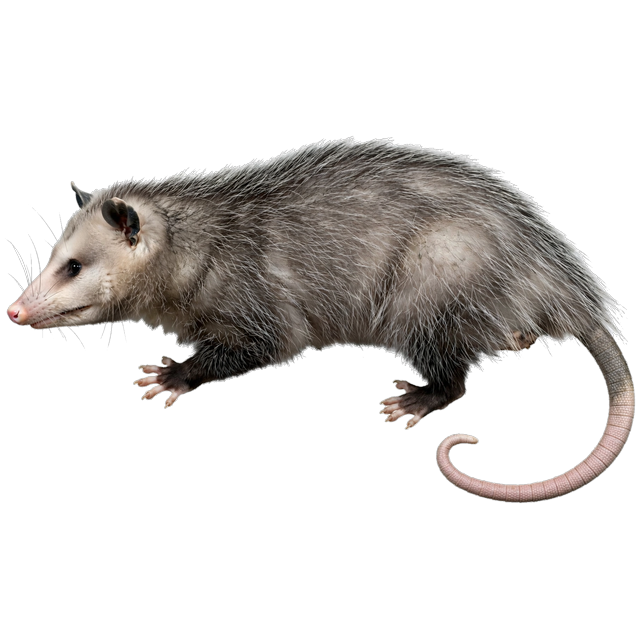
 Virginia opossum
Didelphis virginiana Kerr, 1792
Virginia opossum
North America's only marsupial, 50 teeth and a talent for theatrics.
- Order
- Didelphimorphia
- Family
- Didelphidae
- Group
- Wildlife
- Ontario status
- Native, expanding northward
Why it matters
Garbage and pet-food raiding, denning under structures; eats ticks and slugs, so ecologically useful; rarely a rabies concern.
Origin
Native to eastern North America; expanding northward into Ontario as winters warm.
Behavior
Nocturnal, solitary, slow-moving; the famous 'playing dead' is an involuntary stress response, not a trick; hisses and drools when cornered.
Living conditions
Dens in brush piles, under decks, in attics and garages; needs cover and water; poor cold tolerance sets its northern range limit.
Signs of presence
- Tracks: hind foot shows an opposable 'thumb'
- Overturned compost and raided pet food
- Hissing from under the deck at night
- Leaf nests in sheltered voids
Weaknesses
- Poor cold tolerance, Ontario winters are the range limit
- Thanatosis makes it easy to approach and confirm
- Slow and clumsy, easily excluded by intact structures
Myths and facts
Myth Opossums are rabies-ridden vermin.
Reality Opossums are remarkably rabies-resistant, their lower body temperature makes them poor hosts. They are among the least likely wild mammals to carry rabies.
Research notes
Morphology
Body 33-55 cm, naked prehensile tail 25-40 cm; weight 2-6 kg. Grizzled gray-white fur, pointed snout, 50 teeth, more than any other North American land mammal.
Diagnostics
Naked prehensile tail + opposable hind thumb + 50 teeth; unmistakable in Ontario.
Easily confused with
- Raccoon (Procyon lotor) Raccoon has a furred ringed tail and masked face; the opossum's tail is naked and rat-like with a pointed snout.
- Muskrat (Ondatra zibethicus) Muskrat is semi-aquatic with a laterally flattened tail; opossum is terrestrial with a round prehensile tail.
Life cycle
- Egg
- N/A, marsupial mammal
- Nymph or larva
- Pouch young about 2 months, back-riding about 1 month
- Adult
- Sexual maturity about 1 year; lifespan 2-4 years wild
- Egg to adult
- Gestation about 13 days + pouch development about 2 months
- Generations per year
- 1-2 litters per year
Development
Marsupial: about 13-day gestation; neonates crawl to the pouch, emerge at about 2 months, then ride on the mother's back.
Reproduction
Up to 20+ neonates born, but only about 13 teats, typical surviving litter 7-9 × 1-2 litters/year.
Distribution
- Native range
- Eastern and central North America
- Ontario
- Native, expanding northward with milder winters
- Global
- Not established outside North America
Ecology
Omnivorous scavenger; poor thermoregulation, frostbitten ears and tails common at the range edge; small home range; high predation turnover.
Resistance
Unknown, not applicable.
IPM implications
Exclusion and attractant removal (pet food, compost); range-edge biology means winter itself limits populations. Licensed wildlife-control rules apply (Fish and Wildlife Conservation Act).
Chemical ecology
Anal-gland musk released when threatened (mild beside a skunk); thanatosis is accompanied by drooling and a foul anal secretion that sells the 'corpse' performance.
Genetics and DNA
Reference genome published: chromosome-length assembly (DNA Zoo dv-2k, 2n=22).
Taxonomy
Order Didelphimorphia, family Didelphidae. Didelphis virginiana Kerr, 1792, North America's only marsupial.
Open questions
Rate of northward range expansion in Ontario and its interaction with urban heat islands.
References
- Animal Diversity Web, Didelphis virginiana species account (University of Michigan)
- McManus (1974), Didelphis virginiana, Mammalian Species