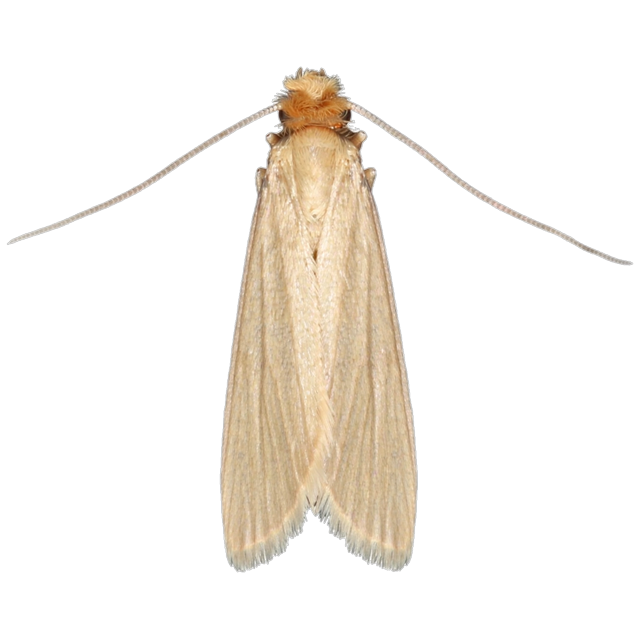
 Webbing clothes moth
Tineola bisselliella (Hummel, 1823)
Webbing clothes moth
A small buff-colored moth whose larvae chew holes in wool, silk, and fur.
- Order
- Lepidoptera
- Family
- Tineidae
- Group
- Moths
- Ontario status
- Established, indoor fabric pest provincewide
Why it matters
Destroys woolens, upholstery, carpets and museum textiles, damage is often found only after months of silent feeding.
Origin
Probably African in origin; now worldwide wherever people store wool and fur.
Behavior
Adults are weak fliers that avoid light; they don't feed at all. Larvae stay hidden in the fabric, spinning silken webbing as they graze, and can feed for months on a single garment.
Living conditions
Dark, undisturbed places: closets, drawers, under furniture, storage boxes. Larvae need animal fibers, wool, silk, fur, feathers, and shun light.
Signs of presence
- Irregular holes in wool, silk or fur garments
- Silken webbing or tubes on fabric surfaces
- Tiny cream caterpillars (~10 mm) in closets or drawers
- Grainy frass the color of the fabric
- Small buff moths fluttering when a closet is disturbed
Weaknesses
- Adults don't feed, only the larvae damage fabric
- Larvae need animal fiber; synthetics and clean cotton are safe
- Light and disturbance drive them away, regularly worn clothes are rarely hit
- Larvae die in heat and prolonged freezing
Myths and facts
Myth The moths eat the clothes.
Reality Adult moths never feed; the larvae do all the damage.
Myth Cedar closets kill them.
Reality Fresh cedar oil repels weakly; it does not kill larvae already feeding in fabric.
Research notes
Morphology
Adults 6-7 mm body, wingspan 12-16 mm; uniformly buff to golden, head with a tuft of reddish hairs. Larvae cream-white, ~10 mm, with a brown head capsule; spin silken feeding tubes (webbing) rather than a portable case.
Diagnostics
Confirm by buff color + webbing on fabric (not a carried case) + larval feeding on keratin. Adults show no wing markings.
Easily confused with
- Casemaking clothes moth, Tinea pellionella Larva carries a portable silken case; adult is mottled gray-brown, not buff.
Life cycle
- Adult
- Lives 2-4 weeks; does not feed.
- Egg
- Laid on keratin materials; hatch in ~1-2 weeks at room temperature.
- Egg to adult
- ~2-3 months at 25 °C; up to 2 years when cool
- Generations per year
- 2-4 indoors per year
- Nymph or larva
- Feeding stage lasts 1-3 months at room temperature, up to 2 years in cool, poor-diet conditions; spins silken webbing.
Development
Complete metamorphosis: egg → larva (many instars, number varies with diet and temperature) → pupa → adult.
Reproduction
Females lay 40-100 eggs on suitable fibers.
Distribution
- Global
- Cosmopolitan indoors
- Native range
- Probably Africa
- Ontario
- Established, indoor fabric pest provincewide
Ecology
Keratin specialist, digests wool, hair and feathers with specialized gut proteases. Larvae avoid light; infestations concentrate in undisturbed storage.
Resistance
Unknown, not a significant insecticide-resistance subject.
IPM implications
Pheromone traps detect adults and map activity, but larvae are the target, inspection must focus on undisturbed keratin materials, not open rooms. The keratin-only diet makes exclusion absolute: no animal fiber, no infestation.
Chemical ecology
Female-produced sex pheromone attracts males, used in monitoring traps; larvae use silk for shelter construction.
Genetics and DNA
No reference genome published as of 2026
Taxonomy
Order Lepidoptera, family Tineidae (fungus moths). Described by Hummel, 1823. The most common clothes moth worldwide.
Open questions
Keratin-digesting gut microbiome composition.
References
- Ebeling, W. Urban Entomology, UC Riverside
- Mallis Handbook of Pest Control