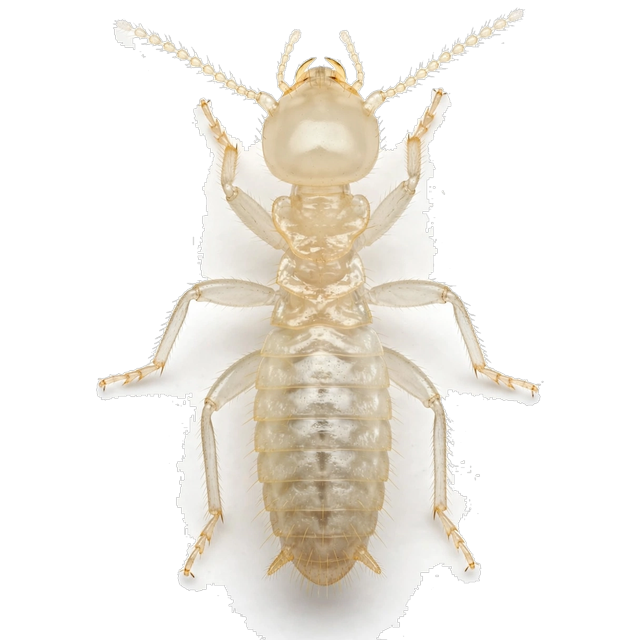
 Western subterranean termite
Reticulitermes hesperus (Banks, 1920)
Western subterranean termite
The West Coast's version of the subterranean termite, same underground habits, different coastline.
- Order
- Blattodea
- Family
- Heterotermitidae
- Group
- Termites
- Ontario status
- Not established in Ontario, western North America species; included as reference for identification and exam contrast
Why it matters
The primary structural termite pest of the Pacific coast; a useful reference for Ontarians because misidentifications in shipped lumber and the identical biology make it exam-relevant contrast material.
Origin
Native to western North America, from British Columbia down the Pacific coast to California.
Behavior
Underground foraging year-round; winged swarmers emerge in spring on warm humid days. Workers avoid light and dry air.
Living conditions
Same requirements as its eastern cousin: soil contact, constant moisture, wood to eat. Builds mud shelter tubes from soil to lumber in coastal homes.
Signs of presence
- Mud shelter tubes on foundations
- Shed wings near windows in spring
- Hollow-sounding wood with mud-packed galleries
Weaknesses
- Desiccates rapidly outside humid shelter tubes or soil
- Colony collapses without its reproductives
- Cold-intolerant compared with the eastern species, limited by climate
Myths and facts
Myth All subterranean termites in Canada are the same species.
Reality Eastern and western Canada have different Reticulitermes species, geography, not appearance, usually separates them.
Research notes
Morphology
Workers ~6 mm, pale, blind. Soldiers with rectangular heads and mandibles; morphometric differences from R. flavipes are measurable but not field-reliable. Alates dark, ~10 mm body, two pairs of equal membranous wings.
Diagnostics
Geography is the practical diagnostic: west of the Rockies = hesperus. Laboratory separation uses soldier head measurements and cuticular hydrocarbon profiles.
Easily confused with
- Eastern subterranean termite, Reticulitermes flavipes Geographic range; morphology overlaps, molecular or morphometric analysis required for certain separation.
Life cycle
- Adult
- Sterile workers/soldiers; winged alates disperse seasonally
- Egg
- ~1 mm, laid by queen in royal chamber
- Egg to adult
- Several months for workers under favorable conditions
- Generations per year
- Perennial colonies persisting many years
- Nymph or larva
- Nymphs develop along worker, soldier, or reproductive pathways under pheromonal regulation
Development
Hemimetabolous with caste polyphenism; no pupal stage.
Reproduction
Single mature queen produces thousands of eggs daily at peak; colonies mature over several years.
Distribution
- Global
- Native range plus limited human-assisted movement
- Native range
- Pacific coastal North America, British Columbia to California
- Ontario
- Not established; reference species only
Ecology
Gut flagellate symbionts digest cellulose; foraging via shelter tubes; moisture-obligate.
Resistance
Unknown, no significant documented resistance; limited study compared with eastern species.
IPM implications
Same colony-target logic as R. flavipes: monitor with in-ground stations, manage moisture and wood-soil contact, target the colony rather than foragers.
Chemical ecology
Trail and caste-regulating pheromones as in other Reticulitermes; soldier defensive secretions.
Genetics and DNA
No reference genome published as of 2026.
Taxonomy
Order Blattodea, family Heterotermitidae (revised from Rhinotermitidae, Hellemans et al. 2024). Eusocial with worker/soldier/reproductive castes; caste polyphenism as in R. flavipes.
Open questions
Northern range limits in BC under climate change; hybridization potential where ranges meet other Reticulitermes.
References
- Bignell, D.E., Roisin, Y. & Lo, N. (eds.) (2011). Biology of Termites: A Modern Synthesis. Springer.