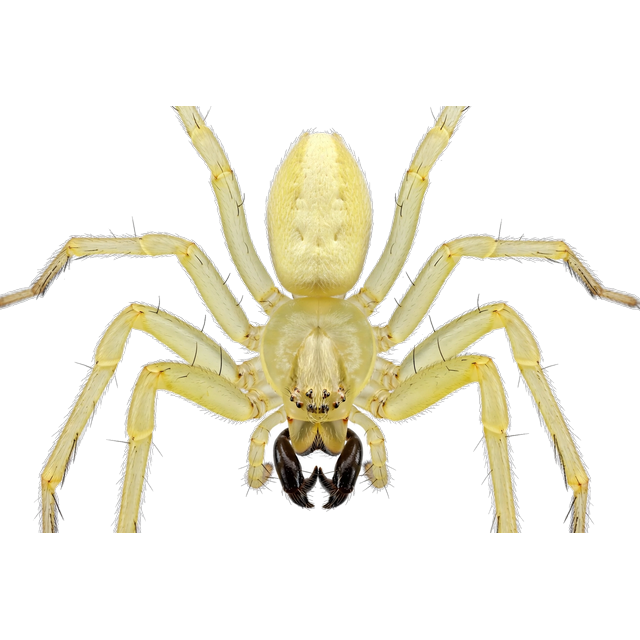
 Yellow sac spider
Cheiracanthium mildei L. Koch, 1864
Yellow sac spider
The pale spider sleeping in a silk sleeping bag behind your picture frames, blamed for far more bites than it delivers.
- Order
- Araneae
- Family
- Cheiracanthiidae
- Group
- Spiders
- Ontario status
- Established, introduced; common indoor nocturnal hunter
Why it matters
It eats household insects and its bite, while possible, is a mild local irritation, not the flesh-destroying wound of legend. The vast majority of 'sac spider bites' diagnosed in clinics turn out to be skin infections or other conditions.
Origin
Europe and the Mediterranean; arrived in North America with human trade and now lives in our houses.
Behavior
Nocturnal wandering hunter; does not use a web to catch prey. Fast and defensive when cornered. Rests in its silk sac by day.
Living conditions
Indoors in upper wall corners, behind pictures and curtains, in window frames. Spins a small silk tube, a daytime sleeping bag, and comes out to hunt at night.
Signs of presence
- Small white silk tubes (about the size of a thumbnail) in upper corners and behind wall hangings
- Pale yellow spiders with noticeably dark jaws seen at night
- Egg sacs guarded inside the silk retreat in summer
Weaknesses
- Depends on its daytime retreat, removing clutter and sealing behind-wall voids removes its shelter
- Desiccates in dry air; does poorly in well-ventilated dry rooms
- Eggs are laid inside the silk sac, so vacuuming the sac removes the whole next generation
- Active at night, so daytime inspection finds them resting and easy to capture
Myths and facts
Myth Yellow sac spiders cause necrotic, rotting bite wounds.
Reality Verified bites produce mild redness at most. Medicine has never documented necrosis from this species; the reputation comes from misdiagnosed infections, including MRSA.
Research notes
Morphology
Body length 7-10 mm; pale yellow to beige carapace and legs; dark brown to black chelicerae (a useful field mark); abdomen pale with a faint dorsal stripe. Legs long, first pair directed forward.
Diagnostics
Pale spider + dark jaws + silk tube retreat in an upper corner. Confirm against Clubiona (native sac spiders) by genitalia; habitus is usually sufficient for genus-level field ID.
Easily confused with
- Native sac spiders (Clubiona spp.) Nearly identical in the field; reliable separation needs microscopic examination, for management purposes the distinction rarely matters.
- Brown recluse (Loxosceles reclusa) Recluses have six eyes in three pairs and no dark jaws; sac spiders have eight eyes and prominent dark chelicerae. Different families entirely.
Life cycle
- Adult
- Adults live about 1 year; overwinter indoors as adults or subadults
- Egg
- 30-50 eggs per sac, guarded by the female inside the silk tube
- Egg to adult
- Several months at room temperature
- Generations per year
- 1-2 indoors
- Nymph or larva
- Spiderlings disperse after first molt; several molts to maturity
Development
Egg to spiderling to adult through successive molts. Female guards the egg sac inside her silk retreat.
Reproduction
Males wander at night seeking female retreats. Female produces 1-2 egg sacs per season and guards them aggressively, most defensive encounters happen at the retreat.
Distribution
- Global
- Introduced and established across North America; holarctic
- Native range
- Europe, Mediterranean basin
- Ontario
- Established indoors province-wide; common in homes
Ecology
Nocturnal cursorial predator of small insects and other spiders. Synanthropic in North America; outdoor populations on vegetation, indoor populations in wall voids and ceiling-wall junctions.
Resistance
Unknown, not a pesticide target; no documented resistance.
IPM implications
Monitoring: count silk retreats in upper corners during daytime inspection. Management is physical, vacuum retreats and sacs, declutter wall hangings, seal cracks at the ceiling-wall junction. The medical-myth dimension matters: part of the job is reassuring clients with evidence, because fear of this spider drives unnecessary chemical use.
Chemical ecology
Venom contains insecticidal peptides; mammal effects are mild local cytotoxicity at most. The necrosis myth has been tested directly: venom assays and verified-bite case series show no necrotic activity. Silk used for retreats and egg sacs, not prey capture.
Genetics and DNA
No reference genome published as of 2026.
Taxonomy
Order Araneae, family Cheiracanthiidae (formerly placed in Clubionidae/Miturgidae). Authority L. Koch, 1864. Introduced Palearctic species, now holarctic in distribution.
Open questions
Venom proteome incompletely described; true bite incidence in Ontario unmeasured.
References
- Foelix, R.F. (2011). Biology of Spiders, 3rd ed., Oxford University Press.
- Vetter, R.S., UC Riverside spider-bite myth research (various publications).